
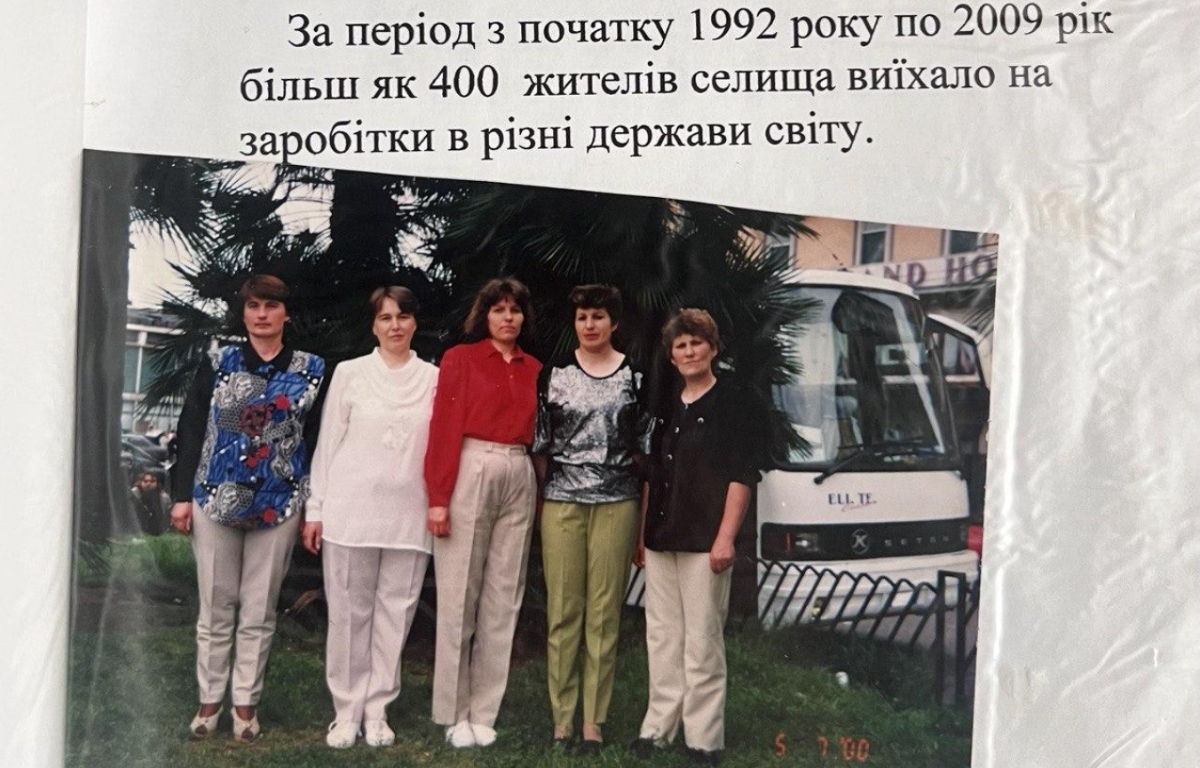
I encountered this photograph at the local museum in Stara Ushytsia village, and it sparked my curiosity not only about the histories of the women depicted, but also about the experiences of women like them—zarobitchanky. According to the museum’s commemorative book listing the village’s most notable residents, between 1992 and 2009, more than 400 people migrated to countries such as Italy, Portugal, Spain, Greece, Germany, and Russia, a striking number for a village of approximately 2,000 inhabitants. The photograph thus offers a starting point for understanding a much broader process of post-Soviet economic transformation and the feminisation of migration.
In Ukrainian mass culture, the experiences of zarobithcanky are told through dramatised narratives of family separation, work-related hardship, and transgressive sexual behaviour. Women who migrate for work are framed as morally dubious yet resilient. However, there is no recognition of structural issues that force them to migrate. How is the figure of the Ukrainian zarobitchanka constructed in public discourse of the 2000s and 2010s, and to what extent is this image representative? Did women migrate for a better life, out of economic necessity or as an act of sacrifice?
The lived stories of zarobitchanky suggest a complex reality of experiences, and we argue that zarobitchanstvo is organised around a politics of temporariness: a return-oriented migration in which women are expected to remain socially and morally attached to Ukraine while living abroad for many years. Women pursued financial independence but did not use it to their advantage: for decades, they kept their lives abroad provisional through practices of deliberate non-belonging—avoiding settlement, marriage, or so-called integration. Finally, we use the notion of home-making through absence to describe how zarobitchanky produce and protect “home” from afar materially through remittances, building a house in the country of origin, and debt repayment, and symbolically through continued attachment, obligation, and the promise of return. This practice helps preserve moral legitimacy vis-à-vis the society of origin, even when they remain abroad for an extended period. In this sense, the promise of return works not only as a private aspiration but as a moral demand that influences how zarobitchanky narrate themselves to families and broader publics, and how they evaluate what is sayable about life abroad. Migration scholarship on the “myth of return”1 is useful here not because return is always achieved, but because the orientation toward return can structure attachments, strategies, and relationships to both the homeland and the host country.
The result of such moral policing is that long-term integration, emotional ties abroad, and new intimate relationships (including sexuality) can become taboo, because they threaten the claim of staying “only temporary” and thus risk being read as moral failure. At the same time, for some women, zarobitchanstvo could be a form of new financial independence, precisely because it turned care work—labour that is often expected and unpaid within the family in Ukraine—into waged employment abroad. We argue that the condition of prolonged temporariness for zarobitchankas dictates what kinds of subjectivities—worker, partner, or a woman “with a life abroad”—can be publicly recognised without stigma or the pressure of cultural and media representation. Simply put, a condition of self-sacrificing victims does not allow a woman to build a life abroad. The transience of zarobitchanka is not only a self-presentation addressed to audiences “at home,” but also the way these women are seen in host countries, which also affects the ability to build relationships.
This article employs a qualitative approach that combines cultural analysis, interview-based research, and close reading of primary sources from zarobitchanka. We closely analyse selected Ukrainian cultural works about zarobitchanky (including the film The Nest of a Turtledove (2016), Natalia Doliak’s novel Hastarbaiterky (2012), Oksana Drackovska’s memoir A Diary of Zarobitchanka: Nanny-Motherland (2009)) to identify recurring themes and storylines about care work, family, morality, intimacy, and, most importantly, the recurring theme of being “temporary” abroad and the expectation of return. Rather than aiming for statistical representativeness, our goal is to show how cultural narratives and lived experiences reinforce or challenge a common perception about zarobitchanky, and how return-oriented logic shapes what parts of respondents’ lives are seen as acceptable and which remain difficult to speak about.
Placing literary and cinematic representations in dialogue with interviews allows us to notice the repeated cultural and narrative mechanisms through which prolonged return-orientation is produced, policed, and internalised, even when return does not happen. This approach helps explain why certain subjectivities (self-sacrificing worker, moral mother, provider with conditional agency) remain culturally recognisable, while others (settled migrant, partner, woman “with a life abroad”) are frequently policed.
Historical background
To understand why so many women from places like Stara Uchysia became migrant workers, one must trace the political and economic transformations that followed Ukraine’s independence. After the dissolution of the Soviet Union, the country began a process of transition from a planned to a free-market economy, leaving many citizens in economic precarity. The post-Soviet economic restructuring and neoliberal labour market reforms had a disproportionate impact on women’s employment. The feminised sectors—teaching, medicine, engineering, public administration, academia—which had provided stable, often prestigious employment for women under the Soviet system, were hit particularly hard. Many well-educated women turned to informal trade, reselling goods at street markets. For others, migration to countries like Poland, Italy, and Spain became a strategy to sustain their livelihoods and support their families. Some women began seeking employment in. As the Western European population aged faster, demand for care and domestic services increased. Simultaneously, the growing participation of Italian women in the workforce meant that traditional caregiving roles were increasingly outsourced to labour migrants.2 This created an opening for Ukrainian zarobitchanky, who were able to provide their labour to meet these needs, often beginning work immediately upon arrival, without legal status and labour protections, and performing physically and emotionally demanding work.
At the same time, in Ukraine, gender roles were being reimagined, as women were offered to return to more traditional roles as full-time housewives and sacrificing mothers, rather than remaining Soviet “mother-workers.” The neo-traditional turn meant to distance the country’s social roles from the Soviet past and return it to a more “authentic” version of womanhood that existed in the imagination of narodnyky in the pre-Soviet period.3 In the public discourse, labour migration abroad was often framed as a threat to, or even a betrayal of, the nation-building project. Female migrants were portrayed as failing to meet the ideal of the “proper mother” and “proper female citizen.”4
As a counterpoint to political narratives centred on labour force loss, Fedyuk, in the interview with Riabchuk, emphasises that remittances contributed significantly to the formation of a segment of Ukraine’s middle class, a contribution often more substantial economically than that of all foreign investments.5 In the European ranking, Ukraine is the fourth-largest recipient of remittances, based on data from 1996 to 2024 on personal transfers and compensation of employees.6 Therefore, the Ukrainian female labour migration is inherently political and complex—its economic benefits intersect with the absence of the migrants in the public political life, who are thus often portrayed as and reduced to heroes, victims, traitors to the state, or mothers abandoning their families.
***
The gendered aspect of migration from Ukraine is often framed through the ideas of the so-called “care drain”—the inability of women who perform care work abroad for wage to fulfil their caring responsibilities back home. The debates about care drain and moral panic are also debates about the politics of temporariness: who is allowed to be abroad, for how long, and under what moral conditions. This idea presupposes that most of the care work is performed by mothers and that most of the female migrants are mothers of minors. In addition, Fedyuk notes that female migration in Ukraine has long been framed through a discourse of shame and surveillance.7 Labour migrants were surveilled by the state, which called these women misogynistic slurs for abandoning their children and causing a demographic crisis.8 Volodko reaffirms that the representation of labour migration in the Ukrainian mass media was rather negative: the process of migration itself was viewed as a threat to the subject of mobility, and migrants were constructed as “victims” of failed state policy.9 Furthermore, the media tend to centre migrant women in the discussions of the familial and gender aspects of labour migration. It is the migrant mothers who are positioned as a threat to traditional family structure and as problematic parents who do not take care of their children.10 Volodko argues that the crisis of masculinity in post-Soviet Ukraine is exacerbated through feminised migration. Fathers who stay in Ukraine do not see themselves as the sole breadwinner of the family anymore, but they also are not ready to properly care for their children because of the influence that traditional gender roles have on their behaviour. Mass media, in turn, reproduce these stereotypes, cautioning the public and absent mothers of the dangers of migration. Lutz and Palenga-Möllenbeck come to a similar conclusion about the role of media in reproducing gender roles: “At first sight, the nationwide discourse also appears to blame the absence of both parents; however, when one looks more closely it turns out that concrete examples always scandalize the absence of mothers, not fathers.”11 The authors also draw attention to the discourse on “social orphancy” that is present in regional Western Ukrainian media, which originates from discourses on poverty and street children.12 The term “euro-orphans” refers to children left behind in sending countries, most often by mothers migrating to perform low-paid care and domestic labour abroad. Similarly, “Italian syndrome” refers to the emotional exhaustion and psychological distress experienced by migrant women working for extended periods in Italy’s care sector. Media coverage often uses these categories within a broader rhetoric of national and familial loss. For instance, a 2013 article in The Guardian titled “As Poland loses its doctors and builders, ‘euro-orphans’ are left at home to suffer”13 focuses not on global, local, and political reasons for leaving, but solely on the effects of that process. Academic work can reproduce this moral pressure by centring motherhood, family separation, and children’s well-being as the primary lens.
The framing of female migration through women’s (in)ability to fulfil gender expectations is evident not only in societal discourse but also in the topics of focus in the academic literature. A significant amount of the literature from the 2000s and 2010s addresses the feminisation of migration from Ukraine in the context of transnational families, distant motherhood, and the well-being of children living separately from their mothers. In her article “Where Have All the Mothers Gone? The Gendered Effect of Labour Migration and Transnationalism on the Institution of Parenthood in Ukraine,” Alissa Tolstokorova argues that female migrants experience a double burden of assuming both the role of the breadwinner of the family and performing socially expected mothering duties from afar.14 Volodko’s study of female labour migrants in Poland and Greece similarly shows that women perceive changes in gender roles as only temporary, and upon return from migration, they assume the same traditional social roles in their families.7 Studies by Yarova15 and Levchenko16 focus on the negative consequences of labour migration for underage children who exhibit deviant behaviour in the absence of care from their parents. While these contributions are important in uncovering the issues that women encounter when labour migration and gendered social expectations intersect, this narrative reproduces the assumption that the care drain, which exists because of mothers of non-adult children leaving families, is the most alarming problem in female migration from Ukraine, leaving out other dimensions of their subjectivity and making invisible zarobitchanky with other experiences. Crucially for our argument, this literature also tends to treat migration as a temporary deviation whose legitimacy depends on continued attachment to Ukraine and, often implicitly, the horizon of return.
However, the work of other scholars complicates these narratives. Solari’s analysis of Ukrainian zarobitchanky is among the most influential contributions to scholarship on what she calls “gendered migrant subjectivity,”17 understood as a subject position shaped by the intersection of gender, migration, and post-Soviet economic transformation. Her ethnographic fieldwork in Italy and the United States focuses on Ukrainian women who migrated to perform care work, as well as on the children who remained in Ukraine. The author asks why most of the women she interviewed are in their late forties to sixties, a pattern that leads her to describe their movement as “grandmother-led migrations,” or, as one of her respondents put it, the “babushsky brigade.”18 Her work reveals that in the context of Ukrainian female labour migration during the early and mid-2000s, it was often grandmothers, rather than mothers of young children, who sought employment as domestic workers abroad. This complicates the “global care chain” paradigm,19 which typically assumes that mothers of non-adult children migrate to provide care in Western households, leaving their own children behind and creating a care drain in the sending countries.
Another assumption challenged is the role of mothers as the family’s primary caregivers. In the Ukrainian case, childcare is often performed by the older generation, not by mothers. As Tyldum argues, Western literature on care reinforces the ideology of “intense mothering” and needs to be rethought in contexts where grandmothers routinely step in to raise grandchildren.20 Importantly, when these grandmothers themselves migrated, they often continued to provide emotional and material support from abroad. They practised transnational grandmothering: sent “care packages” from Italy, filled with panettone and chocolate, maintained regular phone contact with families, and remitted money. Their migration, therefore, reshaped rather than severed their role in the family and the circulation of care.
Finally, some fieldwork shines light on dimensions of life in migration beyond the familial relations, expanding the permitted roles of zarobitchanky. Fedyuk’s ethnographic work with Ukrainian female labour migrants in Italy shows that the focus on motherhood trope in public discourse “often both obscures and diminishes women’s often emancipatory experiences in migration,” and while motherhood informs women’s choices in their lives outside the family, their experiences are much more diverse than suggested by the dominant narratives.21
The orientation towards return logic is something that has recently been slowly challenged and changed by zarobitchanky themselves. Interestingly, Fedyuk’s newer ethnographic work reveals a change from the early 2000s: many zarobitchanky now express reluctance to return home to care for their grandchildren, preferring to maintain their professional lives, gradually politicising their work and demanding rights.5 They cherish personal independence abroad while sending remittances to maintain a connection and an obligation. Though Fedyuk agrees that the policing of subjectivities of zarobitchanky is still present, and topics such as long-term integration, emotional ties abroad, sexuality, or building new relationships often remain taboo within the narrative that positions migrant mothers primarily as self-sacrificing victims with endurance, and familial duty as the terms through which migrant women are evaluated.
Taken together, the literature maps two dynamics: first, a popular tendency to read women’s migration only through care, motherhood, and moral panic; and second, empirical evidence that women’s experiences and subjectivities exceed those frames. What remains less clearly conceptualised is the mechanism that holds these dominant narratives in place, namely, a temporal regime in which women are expected to treat life abroad as a limited time of migration and high-risk, low-paid labour, while simultaneously caring for their own families transnationally, and eventually return home.
Zarobitchanky’s lives abroad are often influenced by an inescapable orientation toward returning “someday,” either by their own will or the community’s expectations, which structures their attachments and aspirations. Under this temporal logic, moral legitimacy is protected by a promise, spoken or implied, that migration is temporary and that “real life” remains located at home.
Gendered Moralities of Zarobitchanstvo in Fiction and Film: Care, Intimacy, and Return
A 2016 movie, “The Nest of a Turtledove” (Hnizdo Horlytsi), follows Daryna, a zarobitchanka from an unnamed village in Bukovyna, who works in Italy. The film’s plot is highly dramatic, with tribulations in Daryna’s interpersonal relationships as its main focus. She goes abroad to secure a better future for her teenage daughter and her husband, Dmytro, by earning money to build new tourist housing for their business. At the same time, in Italy, she enters a sexual relationship with her employer, Alessandro, whose elderly mother she takes care of. When she arrives home after 2,5 years of zarobitchanstvo, she learns she is pregnant and has to decide whether to keep the child or not, whether to stay with her family in Ukraine or return to a working life abroad.
There are several topics worth examining in this film: communities of zarobitchanky in the host country, changes in gender and family relations, and the intimacy in the lives of zarobitchanky.
The first scene with Daryna in Italy introduces Halyna, a fellow zarobitchanka from Daryna’s village, who performs the role of a gatekeeper to the migrant labour regime than a source of solidarity. Although women’s families appear to have been on friendly terms in Ukraine, Halyna maintains a clear emotional and social distance in Italy. Access to work is monetised—her job-finding services cost Daryna 500 euros—and even temporary shelter in times of need is withheld, framing survival in migration as an individual responsibility rather than a collective one.
Halyna’s role is ambivalent: she mediates Daryna’s entry into zarobitchanstvo by providing practical tools (an old Italian phrasebook, advice on dealing with employers) and limited emotional support. At the same time, her guidance consistently reinforces a discourse of endurance and discipline. Phrases such as “no one has it easy, so you must endure”22 and “you have to show them you’re a good employee”23 normalise precarity and shift responsibility for exploitation onto the migrant woman herself. Rather than articulating injustice, Halyna’s advice trains Daryna to internalise the demands of care labour and to perform moral worth through obedience.
Significantly, Halyna is the only migrant woman Daryna regularly interacts with outside her employers. The near-total absence of a broader community of zarobitchanky, aside from a single scene of a Ukrainian church service, forecloses the possibility of collective experience or solidarity. The film thus constructs female labour migration as isolating and zarobithcanky as having worth only in relation to their families in the homeland and employers in the host country.
An aspect of zarobitchanka’s life that the film repeatedly scandalises is female sexuality, particularly through narratives of infidelity. Both Daryna and Halyna are portrayed as unfaithful to their husbands, reinforcing a familiar cultural association between women’s labour migration and moral transgression. While the circumstances of Halyna’s affair remain largely unexplored, Daryna’s sexual relationship with Alessandro is shown on screen and framed as a part of the moral dilemma of female migration.
The first sexual encounter takes place in a laundry room after dinner, when Alessandro approaches Daryna and initiates physical contact. Daryna resists briefly before acquiescing, after which the encounter unfolds with her remaining almost entirely passive. This passivity can be read as a narrative strategy that preserves Daryna’s moral “innocence” in the eyes of the viewer: she does not actively seek sex and does not articulate desire. Such representation aligns with dominant cultural norms of female sexuality, where women’s sexual agency is downplayed to mitigate blame.
More broadly, this portrayal reproduces a persistent cultural discourse in which zarobitchanky are associated with sexual availability and betrayal of family norms. Rather than interrogating how gendered labour precarity shapes intimacy, the film sustains a narrative in which migrant women’s sexuality becomes another site of moral regulation. In doing so, it reinforces stigmatising tropes that cast zarobitchanky as morally suspect subjects, while leaving the gendered and classed power structures governing these relationships largely unexamined.
Lastly, the film frames Daryna’s labour migration as transformative for her position within the family in Ukraine, particularly in relation to her husband. Upon returning home, Daryna expresses opinions about the family’s tourist housing construction project, which are met with visible irritation from Dmytro. He explicitly links her newfound assertiveness to her time abroad, accusing her of becoming overly confident after living in Italy. His remark—“I am not the master of the house anymore because you brought money”24—articulates a crisis of masculine authority triggered by women’s transnational labour, echoing Volodko’s discussion of masculinity destabilised by female labour migration.
While abroad, Daryna’s life is marked by precarity and subordination; at home, however, the film constructs her as economically and symbolically empowered. She takes on decision-making roles traditionally associated with male authority: overseeing construction, managing finances, and organising her daughter’s wedding. This contrast produces a narrative in which migrant labour is retrospectively justified by its domestic outcomes and is therefore desirable only insofar as it enables reintegration into the national and familial order. The final scenes depict Daryna choosing to remain in Ukraine. She ignores Alessandro’s calls to return to Italy and decides to raise the child in Ukraine within her family—an ending which resolves the tension between women’s economic independence and nationalist-family ideals by reaffirming the primacy of home, family, and the “motherland.”
Crucially, the film does not question why Daryna’s empowerment depends on her willingness to endure precarious, gendered labour abroad, but also on her returning home and deciding to stay with her family rather than building a new life abroad. This way, the narrative reconciles female agency in migration with traditional gender roles and the expected placement of women within the family and the nation.
Natalia Doliak’s 2012 novel “Hastarbaiterky” (Female Gastarbeiters) tells a story of three Ukrainian women—Haylna, Natalka, and Larysa—who arrived in Berlin in search of better-paying work. All of them come from various parts of Ukraine and have different backstories; however, their lives become entangled through zarobitchanstvo. Halyna comes to Berlin with her second husband, Maksym, after being forced to leave her own home in Kyiv due to pressure from her son and daughter-in-law. Natalka first arrives in Italy, gradually making her way to Berlin, motivated by the prospect of earning money to construct a new family house and “see the world.” And Larysa, struck by poverty and inability to provide alone for her young child, seeks temporary work in Berlin. The characters’ demographics are important to how the story constructs the female obligation to return home, as this expectation weighs more heavily on some characters than others. In the novel, motherhood and mothering function as central organising principles through which female migrant subjects are evaluated. Each protagonist is positioned differently in relation to motherhood, yet all three trajectories ultimately reaffirm maternal responsibility as the primary horizon of female fulfilment.
They are illegally employed in care work and take up new, “easier to pronounce” nicknames—Halle, Tasha, and Laura. Halyna lives with and cares for an opulent aristocrat, Elsa Krage; Natalka works as a cleaner for different households, and Laura is hired to look after a young couple’s child. In Hastarbaiterky, Halyna’s character reminds one of the “babushky brigade” image: her son is already an adult with his own family, and her maternal role is redirected toward her employer, Frau Krage. At the same time, her decisions are guided by the desire to provide for her Ukrainian family, including her husband, son, daughter-in-law, and granddaughter. While her care for Frau Krage grows stronger, her attachment to family in Ukraine diminishes, reaching a point where she is only connected to it through financial obligation. At the same time, her son is depicted as morally bankrupt for seeking his mother’s money without maintaining a proper relationship.
Under Halyna’s influence, the German aristocrat is depicted as becoming more “moral,” which, in the author’s opinion, entails taking up the Bible, attending the philharmonic rather than partying, and replacing “boyfriends” with family gatherings. Care is presented here as a civilising and moralising force that flows from the Ukrainian caregiver to the Western employer, reproducing a familiar trope of Eastern European women as bearers of moral discipline in contrast to the West, which is perceived as losing its “traditional values” through modernisation. Yet this maternal dynamic is fundamentally asymmetrical. Despite Halyna’s emotional and ethical authority, Frau Krage retains full control over Halyna’s finances and living conditions. As a result, the roles of mother and child remain entangled, and Halyna is shown to be justified in staying in Berlin instead of returning home.
Natalka is the only protagonist without children, though her childlessness is framed as temporary and purposeful. Her migration is oriented toward a future act of motherhood—she plans to adopt a child once she earns enough money abroad. In this way, her economic activity is morally legitimised through its orientation toward reproduction, even if that reproduction is deferred and non-biological. Because of childlessness, her choice to work and stay abroad is not punished by the narrative and the logic of the “myth of return.” She is also the character who’s allowed the most liberty in her sexual and platonic relationships: she actively builds a community of zarobitchanky abroad, being the node that connects them with non-Ukrainians in Berlin, and engages in intimacy without being moralised or judged for it.
Larysa’s storyline most explicitly dramatises the cost of transnational mothering. As a single mother of a young boy, she decides to migrate to provide for him materially. Ironically, her paid labour consists of caring for a child the same age as her son, a narrative device that continually foregrounds the emotional toll of separation. Every moment of affection towards the child who is not hers, or of success in caregiving, simultaneously underscores her perceived failure to fulfil her maternal duties at home. Motherhood thus becomes a site of permanent moral deficit: no amount of competence abroad can compensate for physical absence.
The novel’s resolution reinforces this logic. Larysa is ultimately able to return to Ukraine thanks to the money Natalka inherits after Halyna’s sudden death. Although Halyna intended the money to fund Natalka’s adoption, Natalka decides that it will be better used to reunite a mother and child. This decision is framed as ethically self-evident and narratively satisfying. The story closes by restoring Larysa to her role as a “good mother,” suggesting that migration is tolerable only as a temporary sacrifice in the service of normative motherhood. While the novel acknowledges the emotional costs of transnational mothering, it resolves these tensions by reasserting motherhood within the national space.
Hastarbaiterky constructs the obligation to return not as a universal need placed on every migrant woman but as a conditional moral imperative that depends on a woman’s position within the matrix of motherhood and care. Halyna and Natalka are temporarily exempt from the “myth of return” precisely because their maternal roles are displaced or deferred: Halyna’s mothering is redirected toward her employer, while Natalka’s is projected into the future. In both cases, the narrative permits a prolonged stay abroad, framing it as morally justified by care or reproductive intent. Larysa, by contrast, embodies the figure for whom return is non-negotiable. As a single mother, her prolonged absence from the national and familial space is depicted as a moral failure that can only be resolved through physical reunification with her child. The novel’s resolution thus reaffirms return as the necessary condition for “good motherhood,” rendering migration acceptable only as a temporary sacrifice.
Oksana Drachkovska’s The Diary of Zarobitchanka and “Nanny-Motherland”
Oksana narrates her story in The Diary of Zarobitchanka and “Nanny-Motherland” (2005) memoir with humour, and careful attention to her employers, environment, and other zarobitchanky she meets in the Spanish island, where she travelled with her husband, leaving their young son in Ukraine.
In this family’s case, both parents chose to become zarobitchany to pursue the aspirational “better life” narrative. Oksana’s lens in the memoir is hopeful and persistent. This mindset of migration for finding new possibilities, more common among later “waves” of labour migrants, allowed Oksana to enjoy her time in the host country, despite taking on numerous jobs in cleaning and caring for an elderly woman, which caused her a lot of distress. She is impressed by what she sees after work, “that evening I saw Spain that I dreamed about… Not far from our apartment, in the working-class bar ‘International,’ which migrant jokingly called ‘the Intensive Care Unit,’ two Andalusian guys were playing guitars and singing flamenco on an improvised outdoor stage.”25 The memoir becomes a site where zarobitchanka’s subjectivity is expressed freely and sincerely, with a place for joyful moments, Oksana even calls herself a “labour tourist,” implying that there were possibilities to visit the beach often, and even travel for pleasure, though she mentions that “without cameras in our bags, we would look like Ukrainian illegal migrants, and we were indeed illegal.”26
Oksana and her husband meet another Ukrainian couple strolling across the beach, “a respected Galician couple, Petro and Nina, who had four children at home and a small business… It is not like they were bankrupt or something bad happened. Because of all the daily expenses, they could not afford to finally build their dream house.”27 The aspiration-despite-difficulties nature of migration and home-making from a distance is what characterises most zarobitchany in the memoir.
The narrator admits the transitional nature of her time on the island: she has clothes suitable only for work, she reluctantly builds new friendships, and she does not furnish the communal migrant house, thinking about how she would renovate her kitchen back at home—everything to save the particular amount of money and come back eventually.
In the memoir, motherhood is morally policed not by Oksana’s family or community in Ukraine but by another migrant, a Filipino woman, who advises her to “go home and be with her child.”28 Oksana looks at the pictures of her son, thinking about how much he has changed in three months and what would happen if she stayed longer.
Further in the text, Oksana writes that “in the West, people are not used to sacrificing their lives to children, unlike people with ‘our’ mentality,”29 and this is why they hired her, a responsible, hard-working nanny, who does not smile enough, which is seen as “something typical for Eastern Europeans.”30 The employers, a Spanish-Italian couple, paid Oksana poorly and constantly changed the work schedule, adding more responsibilities, while praising her for good work. She writes about feeling extreme frustration, mentioning that “they [employers] have rights to feel pain and complain about difficulties in their lives because they are paying… and I do not have that privilege.”31 Oksana is constantly aware of how differences in class and financial status between herself and employers create unequal power relations, including who is granted the right to feel exhausted, voice complaints, and openly express emotions.
Once, when Oksana was incredibly tired from running around with the child she cared for in her hands, she cheered herself, thinking she had no right to be annoyed because her current job is “a once-in-a-lifetime opportunity for zarobitchanka.”32 At the same time, she acknowledges that despite many “proper” moms disagreeing with her, it is necessary to take breaks from babysitting kids, even if they are your own. Klara, the mom of the child, is never seen doing any housework, because the stereotypical women’s work was outsourced to illegal worker Oksana.
Oksana makes a lot of comparisons between “there” and “home” throughout the text. Standing in Barcelona’s airport, where she makes a stop before flying back home, she says, “It is provincial everywhere in Ukraine, but I really want to go back.”33 She sets her decision to return against the position of other zarobitchany she meets abroad who cannot, or do not wish to, go back “because there is nothing in Ukraine.” Returning after only one season of work is narrated as a personal victory, rather than a failure in migration.
Olena: “All I dreamed about was to put my hands into the soil near my house in Ukraine”
The interview recorded for this project was with Olena, now 65, a zarobitchanka and grandmother of three, whose migration to Italy followed the death of her husband. Before moving, she worked as a Ukrainian language teacher and retired early. Unable to pay the debts on the house her husband had built in western Ukraine, she left in the early 2000s through a travel agency that was recommended by her friend, a fellow zarobitchanka. Olena was asked to pay a 300-euro fee to obtain a tourist visa and enter the host country. It was almost a “standard” pathway at the time, used by many zarobitchnkas with the aspiration to legalise after.
Olena took full financial responsibility for the house, hoping her grandchildren would inherit it, and supported them through remittances, thus reassuring her belonging and practising transnational grandmothering. Unlike the numerous cultural representations, Olena’s story is closer to Solari’s concept of “babushky brigade,” a grandmother-led labour migration challenging the idea that older women were immobile local caregivers. Olena spent all her earnings from abroad on repairing the house, making construction decisions, paying off debt, and engaging in transnational homebuilding.
In Italy, Olena’s employment was structured as an open-ended arrangement with unequal power relations: she was expected to remain in the household for as long as the elderly man she cared for remained alive. As the woman described it, the employer’s family “would not let her go,” blurring the boundary between formal employment and a personal obligation based solely on verbal agreement. The tension in this arrangement was exacerbated by the fact that work took place in the employer’s home, and the worker’s presence was naturalised as “help” rather than recognised as regulated labour.
“Because you live inside their home, you are always available: you eat there, you sleep there, you are there when he [the man she performed care work for] wakes up. So you don’t have a shift that ends. I asked once, ‘Can I go to church on Sunday?’ and the daughter said, ‘And who will stay with him?’ Like it was obvious. Later, when I talked about going home for a short time, they said, ‘Now it’s impossible, he is worse.’ So it became like this: while he is alive, you stay. Nobody said it directly, but that was the rule.”
Along with the difficult work conditions, the theme of longing for home and romanticisation of return, the day when she would be able to go back to her village in Ukraine, was one of the most prominent in the interview. The indefinite term of the contract made the orientation towards return almost a dream-like scenario.
“When the full-scale invasion started, everything here in Italy went quiet for me. I could be standing in their kitchen, stirring soup, and in my head, I was already in my yard. I wanted to go back to my village and put my hands into the soil near my house, not to plant anything, not even to work, just to touch it. Like you touch a person’s body to make sure they’re alive. I wanted to feel that the earth is still there, that my home is still there, and that I still have a place to return to.”
Olena’s desire “to put her hands into the soil” near her house points to home not only as a location but as an embodied relationship to place, memory, and home. Her house was a material trace of her marriage and a memorial to her husband, something she could not afford economically or emotionally to lose. It had a deep sentimental value. She left home to save home. The “soil” is the dream about the possibility of return that is sensorial and intimate, while the house is the concrete object through which return is imagined and justified, making her hardship with illegal precarious employment meaningful.
Olena describes her return to Ukraine with great enthusiasm and almost magical circumstances. Right after the full-scale invasion had started, the man for whom she cared died, and she no longer had the obligation to stay in Italy. After her arrival, Olena describes feeling guilty and disillusioned: her children and grandchildren had already grown up and had lives of their own. She felt they no longer needed her physical presence in their lives. Olena realised she would be unable to live on her pension in Ukraine and, unwilling to be a burden, returned to Italy. With a recommendation from a previous employer, she started a similar job with better conditions, saying, “I began, for the first time, to live a life for myself.” With no obligation to the grown children, Olena finally tried to grow more permanent roots in Italy.
***
The materials examined in this project reveal a shared discursive framework through which Ukrainian female labour migration is made intelligible, while also exposing important tensions between narrative closure and lived experience. Across the cultural texts, zarobitchanky are consistently constructed as moral subjects through their orientation toward family and home in Ukraine. While characters often question their decisions about the prospect of return, the narrative often demands a choice that is grounded in women’s relationships to family in Ukraine, leaving limited space for female agency. These texts can be seen not only as representations of female labour migration but also as examples of cultural discourse that disciplines migration, offering normative scripts for how zarobitchanky should understand their own agency and place themselves in relation to temporariness.
The lived experiences of zarobitchanky complicate these narratives of temporariness. Instead of functioning solely as a return-oriented condition, temporariness emerges in interviews and memoirs as a contested, sometimes productive state. Orientation toward home sustains the aspirational logic of “labour tourism” and provides a narrative coherence to otherwise precarious life circumstances. At the same time, temporariness can guide decisions while remaining ambiguous. Migration might not be a linear trajectory from departure to return, but a cyclical and contingent process shaped by different life circumstances.
Thus, home-making from a distance emerges as a key point of convergence between cultural representations and lived experience. Literal practices of home-building and remittances make the endurance of work that is often informal or illegal, dependent on employers’ goodwill, and lacking labour protections, morally intelligible and socially justified. Yet this same orientation toward home operates as a constraint: the expectation of eventual return limits the possibility of settling into life abroad and naturalises migrant women’s exclusion from stability in the host country. Temporariness thus functions not only as a temporal condition but as a disciplinary logic that renders zarobitchanky’s precarity acceptable: rather than seeing their absence as a structural feature of the global care regimes, it is assumed to be a temporary deviation from the “proper” social order in Ukraine.
References
Al-Rasheed, Madawi. “The Myth of Return: Iraqi Arab and Assyrian Refugees in London.” Journal of Refugee Studies 7, no. 2-3 (1994): 199–219. https://doi.org/10.1093/jrs/7.2-3.199.
Connolly, Kate. “As Poland Loses Its Doctors and Builders, ‘Euro-Orphans’ Are Left at Home to Suffer.” The Guardian, March 15, 2015. https://www.theguardian.com/world/2015/mar/15/euro-orphans-fastest-shrinking-town-poland-radom.
Doliak, Natalka. Hastarbaiterky [Female Gastarbeiters]. Klub Simeinoho Dozvillia, 2012.
Drachkovska, Oksana. Nianka-Nenka: Zi Shchodennyka Zarobitchanky” [Nanny-Mother: From the Diary of a Migrant Woman]. Kyiv: Kalvariia, 2009.
Ehrenreich, Barbara, and Arlie Russell Hochschild. Global Woman : Nannies, Maids, and Sex Workers in the New Economy. New York: Metropolitan Books, 2003.
Fedyuk, Olena. “Beyond Motherhood: Ukrainian Female Labour Migration to Italy.” PhD thesis, 2011. https://www.etd.ceu.edu/2011/fedyuk_olena.pdf.
Hochshield, Arlie R. “Global Care Chains and Emotional Surplus Value.” In On the Edge: Living with Global Capitalism, edited by Will Hutton and Anthony Giddens, 130–49. London: Jonathan Cape, 2000.
Levchenko, Kateryna, ed. Problems of the Children of Labor Migrants: An Analysis of the Situation [Problemy Ditei Trudovykh Mihrantiv: Analiz Sytuatsii]. Kyiv: Agency Ukraine LLC, 2006.
Lutz, Helma, and Ewa Palenga-Mollenbeck. “Care Workers, Care Drain, and Care Chains: Reflections on Care, Migration, and Citizenship.” Social Politics: International Studies in Gender, State & Society 19, no. 1 (January 18, 2012): 15–37. https://doi.org/10.1093/sp/jxr026.
Penkala, Alina, Ilse Derluyn, and Ine Lietaert. “Good Mothers, Bad Mothers: Migrant Ukrainian Women Negotiating to Belong.” UNU-CRIS Working Papers, no. 6 (2023): 1–14. https://cris.unu.edu/sites/cris.unu.edu/files/UNU-CRIS_Working-Paper_Penkala-Derluyn-Lietaert_23.06_0.pdf.
Riabchuk, Anastasiia, and Olena Fedyuk. “Beyond Sacrifice: The Taboo Topics of Female Migration (Za Lashtunkamy Zhertovnosti: Tabujovani Temy Zhinochoyi Migraciyi).” Commons, January 19, 2022. https://commons.com.ua/uk/za-lashtunkamy-zhertovnosti-tabujovani-temi-zhinochoyi-migraciyi/.
Solari, Cinzia D. On the Shoulders of Grandmothers. Routledge, 2017.
The Nest of a Turtledove. 4 rooms film, 2016.
Tolstokorova, Alissa V. “Where Have All the Mothers Gone? The Gendered Effect of Labour Migration and Transnationalism on the Institution of Parenthood in Ukraine.” The Anthropology of East Europe Review 28, no. 1 (January 1, 2010): 184–214.
Tyldum, Guri. “Motherhood, Agency and Sacrifice in Narratives on Female Migration for Care Work.” Sociology 49, no. 1 (December 15, 2014): 56–71. https://doi.org/10.1177/0038038514555427.
Volodko, Viktoria. “Representation of the Modern Ukrainian Labour Migration in Printed Media.” Ukrainian Society 19, no. 2 (April 16, 2007): 90–101. https://doi.org/10.15407/socium2007.02.090.
—. “The Impact of Labor Migration on Family Roles of Contemporary Ukrainian Women (Based on Work Experience in Poland and Greece) [Vplyv Trudovoi Mihratsii Na Simeini Roli Suchasnykh Ukrainskykh Zhinok (Z Dosvidom Roboty U Polshchi Ta Hretsii)].” PhD dissertation, 2011.
World Bank Open Data. “World Bank Open Data,” 2026. https://data.worldbank.org/indicator/BX.TRF.PWKR.DT.GD.ZS?locations=UA.
Yarova, Olha. “The Impact of Migration of Ukrainian Women to Italy on Their Families in Ukraine.” In Migration Processes in Central and Eastern Europe: Unpacking the Diversity, edited by Alice Szczepaniková, Marek Čaněk , and Jan Grill, 38–42. Multicultural Center Prague, 2006.
Zhurzhenko, Tatiana. “Free Market Ideology and New Women’s Identities in Post-Socialist Ukraine.” The European Journal of Women’s Studies 8, no. 1 (2001): 29–49.
- Madawi Al-Rasheed, “The Myth of Return: Iraqi Arab and Assyrian Refugees in London,” Journal of Refugee Studies 7, no. 2-3 (1994): 199–219, https://doi.org/10.1093/jrs/7.2-3.199. [↩]
- Barbara Ehrenreich and Arlie R. Hochschild, Global Woman: Nannies, Maids, and Sex Workers in the New Economy (New York: Metropolitan Books, 2003), 32. [↩]
- Tatiana Zhurzhenko, “Free Market Ideology and New Women’s Identities in Post-Socialist Ukraine,” The European Journal of Women’s Studies 8, no. 1 (2001): 41. [↩]
- Alina Penkala, Ilse Derluyn, and Ine Lietaert, “Good Mothers, Bad Mothers: Migrant Ukrainian Women Negotiating to Belong,” UNU-CRIS Working Papers, no. 6 (2023): 10, https://cris.unu.edu/sites/cris.unu.edu/files/UNU-CRIS_Working-Paper_Penkala-Derluyn-Lietaert_23.06_0.pdf. [↩]
- Anastasiia Riabchuk and Olena Fedyuk, “Beyond Sacrifice: The Taboo Topics of Female Migration (Za Lashtunkamy Zhertovnosti: Tabujovani Temy Zhinochoyi Migraciyi),” Commons, January 19, 2022, https://commons.com.ua/uk/za-lashtunkamy-zhertovnosti-tabujovani-temi-zhinochoyi-migraciyi/. [↩] [↩]
- “World Bank Open Data,” World Bank Open Data, 2026, https://data.worldbank.org/indicator/BX.TRF.PWKR.DT.GD.ZS?locations=UA. [↩]
- Olena Fedyuk, “Beyond Motherhood: Ukrainian Female Labour Migration to Italy” (PhD thesis, 2011), https://www.etd.ceu.edu/2011/fedyuk_olena.pdf. [↩] [↩]
- Alina Penkala, Ilse Derluyn, and Ine Lietaert, “Good Mothers, Bad Mothers: Migrant Ukrainian Women Negotiating to Belong,” UNU-CRIS Working Papers, no. 6 (2023), https://cris.unu.edu/sites/cris.unu.edu/files/UNU-CRIS_Working-Paper_Penkala-Derluyn-Lietaert_23.06_0.pdf. [↩]
- Viktoria Volodko, “Representation of the Modern Ukrainian Labour Migration in Printed Media,” Ukrainian Society 19, no. 2 (April 16, 2007): 100, https://doi.org/10.15407/socium2007.02.090. [↩]
- Viktoria Volodko, “Representation of the Modern Ukrainian Labour Migration in Printed Media,” Ukrainian Society 19, no. 2 (April 16, 2007): 97, https://doi.org/10.15407/socium2007.02.090. [↩]
- Helma Lutz and Ewa Palenga-Mollenbeck, “Care Workers, Care Drain, and Care Chains: Reflections on Care, Migration, and Citizenship,” Social Politics: International Studies in Gender, State & Society 19, no. 1 (January 18, 2012): 14, https://doi.org/10.1093/sp/jxr026. [↩]
- Helma Lutz and Ewa Palenga-Mollenbeck, “Care Workers, Care Drain, and Care Chains: Reflections on Care, Migration, and Citizenship,” Social Politics: International Studies in Gender, State & Society 19, no. 1 (January 18, 2012): 12, https://doi.org/10.1093/sp/jxr026. [↩]
- Kate Connolly, “As Poland Loses Its Doctors and Builders, ‘Euro-Orphans’ Are Left at Home to Suffer,” The Guardian, March 15, 2015, https://www.theguardian.com/world/2015/mar/15/euro-orphans-fastest-shrinking-town-poland-radom. [↩]
- Alissa V Tolstokorova, “Where Have All the Mothers Gone? The Gendered Effect of Labour Migration and Transnationalism on the Institution of Parenthood in Ukraine,” The Anthropology of East Europe Review 28, no. 1 (January 1, 2010). [↩]
- Olha Yarova, “The Impact of Migration of Ukrainian Women to Italy on Their Families in Ukraine,” in Migration Processes in Central and Eastern Europe: Unpacking the Diversity, ed. Alice Szczepaniková, Marek Čaněk , and Jan Grill (Multicultural Center Prague, 2006). [↩]
- Kateryna Levchenko, ed., Problems of the Children of Labor Migrants: An Analysis of the Situation [Problemy Ditei Trudovykh Mihrantiv: Analiz Sytuatsii] (Kyiv: Agency Ukraine LLC, 2006). [↩]
- Cinzia D Solari, On the Shoulders of Grandmothers (Routledge, 2017), 2. [↩]
- Cinzia D Solari, On the Shoulders of Grandmothers (Routledge, 2017), 3. [↩]
- Arlie R. Hochshield, “Global Care Chains and Emotional Surplus Value.,” in On the Edge: Living with Global Capitalism, ed. Will Hutton and Anthony Giddens (London: Jonathan Cape, 2000), 130. [↩]
- Guri Tyldum, “Motherhood, Agency and Sacrifice in Narratives on Female Migration for Care Work,” Sociology 49, no. 1 (December 15, 2014): 58, https://doi.org/10.1177/0038038514555427. [↩]
- Olena Fedyuk, “Beyond Motherhood: Ukrainian Female Labour Migration to Italy” (PhD thesis, 2011), 215 https://www.etd.ceu.edu/2011/fedyuk_olena.pdf. [↩]
- The Nest of a Turtledove (4 rooms film, 2016), 28:40. [↩]
- The Nest of a Turtledove (4 rooms film, 2016), 13:05. [↩]
- The Nest of a Turtledove (4 rooms film, 2016), 38:50. [↩]
- Oksana Drachkovska, Nianka-Nenka: Zi Shchodennyka Zarobitchanky” [Nanny-Mother: From the Diary of a Migrant Woman] (Kyiv: Kalvariia, 2009), 40. [↩]
- Oksana Drachkovska, Nianka-Nenka: Zi Shchodennyka Zarobitchanky” [Nanny-Mother: From the Diary of a Migrant Woman] (Kyiv: Kalvariia, 2009), 46. [↩]
- Oksana Drachkovska, Nianka-Nenka: Zi Shchodennyka Zarobitchanky” [Nanny-Mother: From the Diary of a Migrant Woman] (Kyiv: Kalvariia, 2009), 16. [↩]
- Oksana Drachkovska, Nianka-Nenka: Zi Shchodennyka Zarobitchanky” [Nanny-Mother: From the Diary of a Migrant Woman] (Kyiv: Kalvariia, 2009), 61. [↩]
- Oksana Drachkovska, Nianka-Nenka: Zi Shchodennyka Zarobitchanky” [Nanny-Mother: From the Diary of a Migrant Woman] (Kyiv: Kalvariia, 2009), 83. [↩]
- Oksana Drachkovska, Nianka-Nenka: Zi Shchodennyka Zarobitchanky” [Nanny-Mother: From the Diary of a Migrant Woman] (Kyiv: Kalvariia, 2009), 82. [↩]
- Oksana Drachkovska, Nianka-Nenka: Zi Shchodennyka Zarobitchanky” [Nanny-Mother: From the Diary of a Migrant Woman] (Kyiv: Kalvariia, 2009), 102. [↩]
- Oksana Drachkovska, Nianka-Nenka: Zi Shchodennyka Zarobitchanky” [Nanny-Mother: From the Diary of a Migrant Woman] (Kyiv: Kalvariia, 2009), 165. [↩]
- Oksana Drachkovska, Nianka-Nenka: Zi Shchodennyka Zarobitchanky” [Nanny-Mother: From the Diary of a Migrant Woman] (Kyiv: Kalvariia, 2009), 188. [↩]