
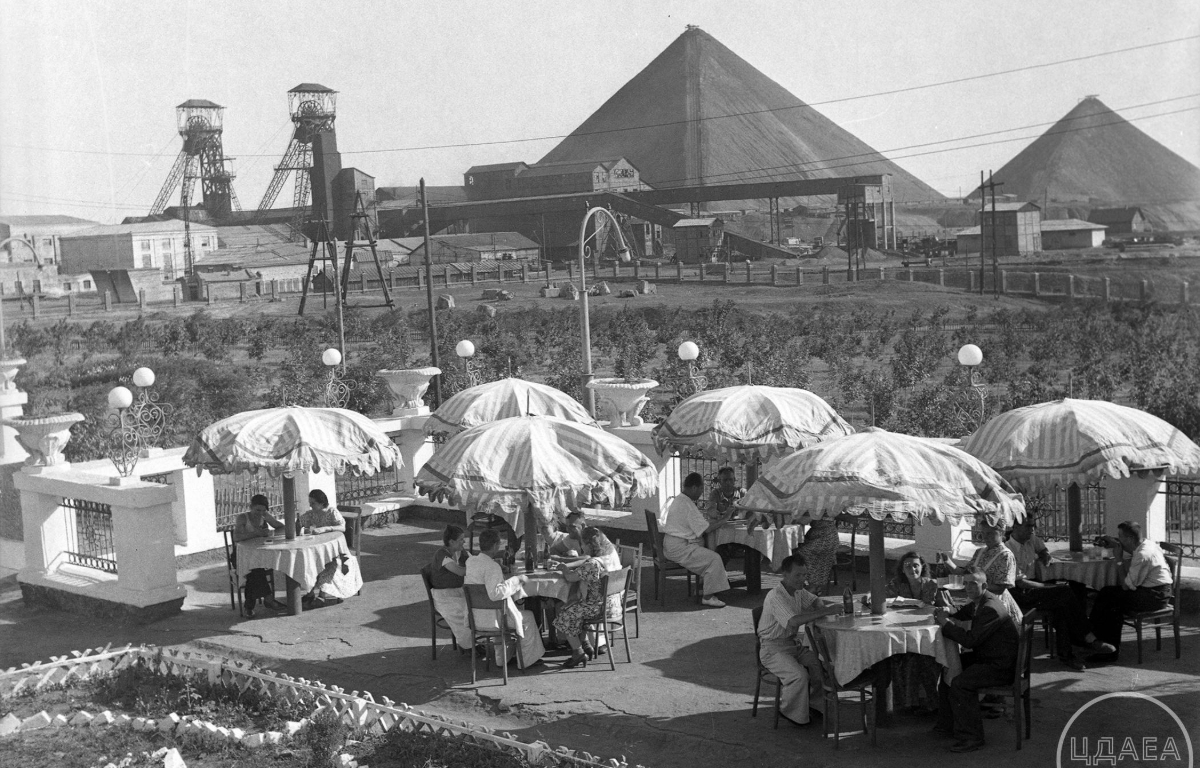
From May to September 1982, visitors to the Yaseny canteen and the Vesna café in Kyiv could taste a range of special dishes: Old Kyiv borshch with sausages, Donetsk-style squid soup, Slavic salad with chicken and mayonnaise, and even an elaborately decorated dish called “Dolphin.” In fact, it was prepared not from dolphin meat but from frozen fish in aspic. All these foods were cooked by leading employees of various restaurant trusts as part of the Republican Review-Competition of Professional Excellence among Public Catering Workers, dedicated to the 1500th anniversary of Kyiv.1
The report on the competition reveals a series of paradoxes. On the one hand, the event intended to promote “advanced food preparation technologies and new labour methods”; on the other hand, “emphasising the city’s ancient past,” the chefs attempted to prepare dishes “whose origins reach deep into national history.” Modern laboratories for evaluating the chemical composition of food products and the latest equipment for preparing dishes—including broths made from stock cubes—operated alongside a Cossack wagon from which supposedly traditional honey drinks and gingerbread were sold. The recipes themselves appear even more revealing. Most dishes whose names were intended to evoke a certain “historical rootedness” incorporated standardised mass-produced ingredients, most notably frozen hake, which was used in everything from pancakes to cabbage rolls.2 Moreover, an active advertising campaign across Expocenter of Ukraine (VDNG) reminded visitors of the importance of “observing fish days”3 —a mandatory state practice introduced in 1976 that sought to offset meat shortages through increased consumption of affordable frozen fish.4 An event intended to symbolise socialist prosperity and a shared Ukrainian-Russian history dating back to the era of Kyivan Rus’ relied on the reuse of stale bread and semi-finished products.
In the USSR, food was one of the instruments of shaping the Soviet person. However, ideas about what this food should be have changed significantly over time. While in the 1930s, the Soviet regime sought to establish new standards of consumption, positioning food primarily as fuel “intended to sustain the normal functioning of our organism exhausted by labor,”((K. Dedrina, Kukhnia na plite i primuse (Leningrad: Leningradskii gublit, 1927), 4.)) after the World War II, the restoration of imperial borders also required the “reordering” of the boundaries of the gastronomic landscape, which led to a dramatic rise in interest in the promotion of the national cuisines of the Soviet republics.5 Although the ultimate goal was to create a common Soviet cuisine, national cuisines were, at least formally, promoted through culinary literature and public catering establishments until the collapse of the USSR.
In this article, I aim to explore how the Soviet modernisation project shaped not only patterns of food consumption in Ukraine but also the very idea of a “traditional Ukrainian cuisine” in the second half of the twentieth century.
The “Invention of Traditional Ukrainian Cuisine” in the USSR
“We live in Ukraine, in our national republic. Yet we are using the works of Levin, published in 1932, and the public catering system operates according to Levin’s rozkladky—and the borscht there is made without potatoes!”—such was the indignation of Comrade Khryashchov, the head of the Kyiv City Public Catering Administration, during a meeting with staff from the Research Institute of Trade and Public Catering (hereafter, the Institute) on 14 December 1948.6 He complained that recipes developed in Moscow either lacked Ukrainian dishes altogether—featuring kulebiaka but not a single varenyk—or failed to meet the tastes and expectations of the local population: “We have long been accustomed to Ukrainian borscht made with Ukrainian lard, have we not, Ivan Ihnatovych? And it should smell of garlic, yet in our borscht, there is not even a trace of aged lard!” Consequently, he expressed hope that the Institute’s staff would immediately undertake the development of recipes for Ukrainian national dishes.6
Indeed, shortly after this meeting, the creation of an “Assortment of Ukrainian Dishes” appeared in the Institute’s research plans. By the end of the year, the assortment had increased by 300 dishes.7 These recipes formed the basis of the recipe specifications for public catering establishments and were subsequently used in the publication of cookbooks intended for the general population.
The acceptance of Comrade Khruschev’s proposal reflected both economic and political objectives. Edward Geist argues that, while officials cited increased turnover, the process “grew out of the USSR’s efforts in the immediate postwar years to integrate the physically devastated and potentially disloyal territories of Western Ukraine into the Soviet political and economic order.”8 However, I consider the question of how the “Assortment of Ukrainian Dishes” was actually created no less important. For the most part, Institute staff did not collect these recipes during ethnographic expeditions. Instead, they used recipes from five Ukrainian cookbooks published in the late nineteenth and early twentieth centuries.9 The authors of these cookbooks were never publicly acknowledged, and their names were effectively erased from cultural memory.
Olena Kisilevska, Olha Franko, and Vira Yashchynska represented urban gastronomy of the 1920s, part of the broader European gastronomic landscape. Nevertheless, working with these sources, Soviet officials selectively incorporated the recipes, arguing that “before the revolution, the ruling classes, in their pursuit of all things foreign, had pushed Ukrainian cuisine out.” These officials, therefore, sought to “purify” Ukrainian culinary heritage of foreign influences.10 Given the political objectives, such an approach was hardly surprising, but its long-term consequence, however, was the marginalisation of Ukrainian urban gastronomic heritage and the reduction of Ukrainian foodways to a rigid, exoticised canon of supposedly “authentic” national dishes. The majority of the recipes were sourced from Zinoviia Klynovetska’s cookbook, published in 1913. Klynovetska’s recipes underwent substantial modifications. First, they were adapted to standardised ingredient allocations according to the category of the catering establishment. For example, in the recipe for Chernihiv borshch, the instruction to use “2 pounds of good fatty meat for the broth”11 was transformed into an allocation of “40 grams of beef per 500-gram serving for first-category establishments and 100 grams of bones for second-category establishments.”12 Second, the Institute’s staff had to reconcile the selected recipes with the established administrative borders, representing an excellent example for Eric Hobsbawm’s “invention of tradition.” ((Eric Hobsbawm and Terence Ranger, eds., The Invention of Tradition (Cambridge: Cambridge University Press, 1983). ))
Consequently, Kuban borshch, which had been included in Klynovetska’s cookbook, could no longer be incorporated into the repertoire of Ukrainian national dishes. Instead, the Institute’s staff developed their own version of Lviv borshch, prepared with sausages.13 Following the transfer of the Crimean Oblast from the Russian SFSR to the Ukrainian SSR in 1954, a new Crimean borshch with meatballs appeared in Ukrainian culinary literature.14 At the same time, Crimea was represented in these cookbooks as an exotic oasis abundant in bay leaves, peaches, watermelons, melons, almonds, pistachios, and wine, while leaving no trace of the culinary heritage of the Indigenous population, which was forcibly deported from Crimea in 1944.15
More broadly, it is important to recognise that the codification of the repertoire of Ukrainian dishes took place immediately after the post-war famine and only a relatively short time after the Holodomor, which had devastated the traditional societies of many regions by physically eliminating the bearers of culinary knowledge.
The newly established Soviet canon of authentic Ukrainian cuisine did not reflect existing culinary practices; rather, it was constructed and represented a new culinary reality, as members of the culinary councils exercised considerable discretion in deciding which recipes developed by the Institute’s staff would be promoted and which would be excluded. For example, potato kulish, kulish with pork fat, mushroom yushka with rice, and shcherba were removed because they had already appeared in the USSR recipe collection of 1949 and therefore could not be presented as specifically Ukrainian. Shpundra was recommended for exclusion as an “unintelligible dish,” while Halytskyi borshch with meat-filled vushka was ultimately rejected on the grounds that it “would find no practical application” in the public catering industry.
Ukrainian Cuisine, the Rise of Semi-Finished Products, and Performative Diversity
In the preface to the popular cookbook Ukrainian Dishes (Ukrainski stravy, 1960), the authors emphasise their role in reviving Ukrainian cuisine following a decline that had supposedly occurred at the end of the nineteenth century. At that time, the French chefs, hired by wealthy families and catering establishments, “brought with them recipes and technologies of Western European dishes and arbitrarily altered the preparation methods of Ukrainian cuisine.”16 Consequently, the publication of recipe collections and the opening of national cuisine restaurants after the Second World War were positioned as a “return to the roots.” However, this proved impossible, because the Soviet food production system was itself a replica of the urban cuisine of the Russian Empire, developed under significant French influence. To obscure this, the Soviet authorities implemented several waves of renaming. During the 1920s, consommé transformed into bouillon, while béchamel became a thick white milk sauce. Notably, according to the same rozkladka, Chicken Kiev was renamed “chicken cutlets stuffed with butter,” though the dish would later return to culinary publications under its original name.17 This process continued in 1949, when éclairs became zavarni, and the Parisian bun was rebranded as the miskyi baton (сity loaf).18 Foreign recipes did not disappear; their names were changed to form the foundation of a pan-Soviet cuisine.
Moreover, the mass production of food staples that underpinned the Soviet supply system was built according to European and American templates. In his memoirs, Anastas Mikoyan detailed this process: in the beginning of the 1930s, he initiated the creation of “modern meat and dairy plants based on the American model,” as well as canning factories for meat, fish, vegetables, and fruit. He regularly sent Soviet engineers abroad to “study the experience of the best enterprises in Europe and especially America, in order to transplant everything advanced onto Soviet soil.” In 1936, Mikoyan personally undertook a mission to the United States, bringing back numerous innovations that became staples of Soviet reality: from the Mikoyan cutlets (originally intended as hamburger patties) to tomato juice, produced as an alternative to American orange juice due to a shortage of citrus fruits.19 This project of radical modernisation inevitably affected national cuisines, despite efforts by Soviet actors to present them as timeless and unchanging.
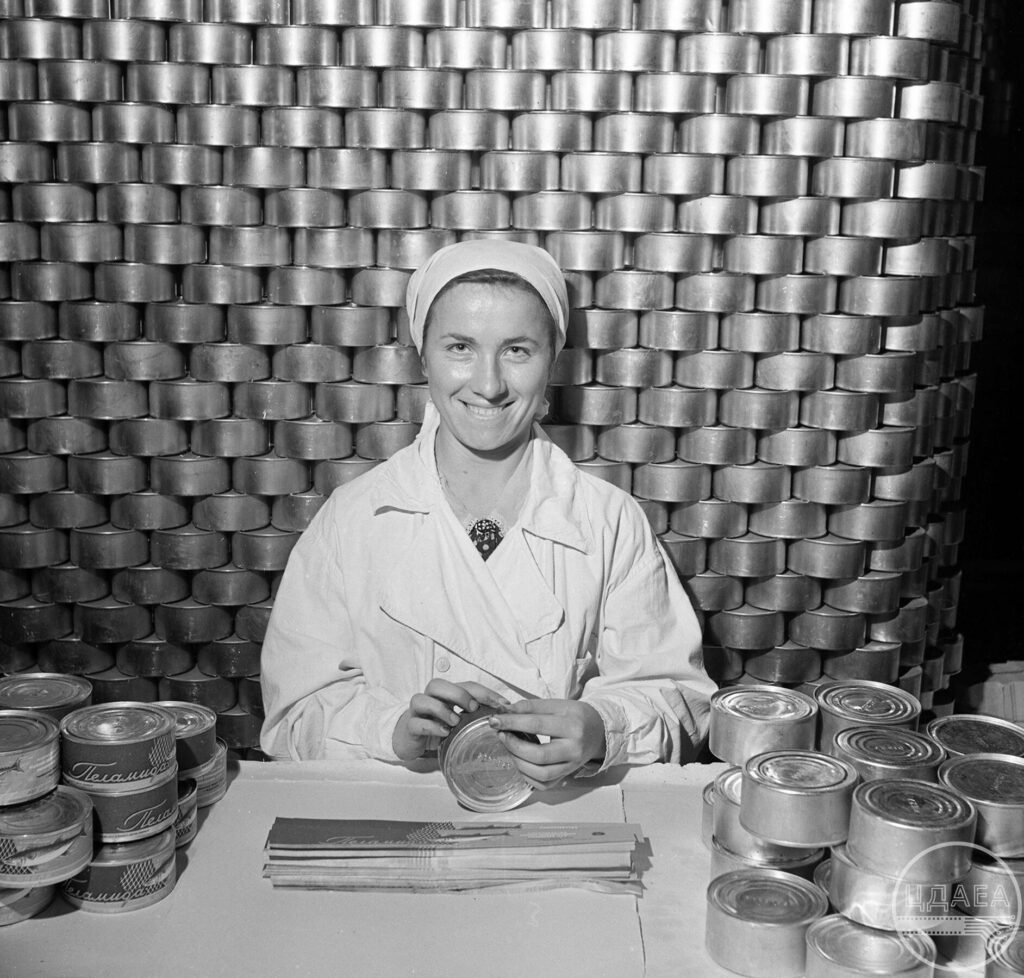
If the production of mass-produced foods was a large-scale experiment in the 1930s, catering establishments could still decide at their own discretion whether and how to use them. However, by the late 1950s, the situation changed. Issued amidst Khrushchev’s economic reforms in 1956 and 1959, the new Measures to Improve the Performance of Public Catering Enterprises required the mass adoption of semi-finished products. ((Central Committee of the CPSU and Council of Ministers of the USSR, O dalneishem razvitii i uluchshenii obshchestvennogo pitaniia, Resolution No. 182, February 20, 1959.))
Moreover, some local actors also emphasised the need for such a step. For instance, during a routine inspection of twenty-one catering establishments in Kyiv, Institute staff discovered that some venues were not preparing any Ukrainian dishes. The managers of these establishments cited various excuses: they “had not received instructions to produce Ukrainian dishes,” “suffered from supply disruptions of lard, dairy products, eggs, garlic, and dried mushrooms,” or “did not have enough pots, sauté pans, and tools.” Some establishments complained that the initially proposed assortment of Ukrainian dishes was too expensive and difficult to implement.20 Isay Feldman, who worked in the industry from the 1950s, recalls that preparing borscht from scratch was a genuine challenge. The large number of ingredients and complex production technology created opportunities for theft and manipulation, persistent features of the industry. Consequently, he and his colleagues not only welcomed the transition to semi-finished products but also participated in their development.21 While canning plants ramped up production across the Ukrainian SSR, Institute staff worked on a global update of recipes intended to solve contradictory tasks: food had to become both more accessible and more palatable simultaneously. Utilising the concept of “rational, physiologically complete dishes,” they revised both set lunches and individual recipes. An examination of the improved lunch reveals that changes primarily concerned portion sizes: the borscht serving was reduced, with the missing 100 grams compensated by the introduction of a vegetable appetiser. The main meat dish was cut to just 45 grams, a difference also meant to be compensated by a vegetable garnish.22 The transformation of Zaporozhian Kapusnyak—a staple of Ukrainian cuisine in the catering establishments of the time—is telling, for the meat vanished completely, and the total number of ingredients was reduced.
A new fat norm was established for first courses: between 8 and 10 grams, depending on the category of the establishment.23 Furthermore, establishments were permitted to replace pork lard and butter with margarine. The usage of semi-finished bases resulted in a borscht recipe consisting of only five ingredients: concentrate, cabbage, potatoes, bell pepper, and margarine.24 This inevitably affected the taste. As Olena Stiazhkina writes, “mangled by its integration into Soviet cuisine (mangled not by outsiders, but by Soviet Ukrainians themselves), borscht, along with other national dishes, remained tasty only if prepared at home.”25 Though it might be marketed as a Ukrainian dish, a meatless borscht cooked with factory-made concentrate and margarine reflected Soviet reality far more accurately than any connection to traditional Ukrainian culinary culture.
Cutlets and the Illusion of Variety in Signature Dishes
The standardisation and simplification of recipes proceeded in parallel with another development: establishments were granted greater autonomy in the creation of signature dishes, while regional trusts submitted proposals for recipes to be included in the updated assortment. Most frequently, these proposals featured minimally modified versions of typical pan-Soviet dishes distinguished by toponymic descriptors, such as Kherson liver pâté or Kherson-style schnitzel.26 Occasionally, they blended the representation of local specificities with broader Soviet trends. The Odesa trust, for instance, proposed not only recipes for eggplant caviar, fried mackerel, and brizols, but also a crab and rice salad, as well as meatballs and beef stroganoff prepared from whale meat.27 The 1960s and 1970s marked the zenith of the Soviet whaling industry; against the backdrop of declarations of intent to “overtake and surpass America” in the production of meat and dairy, the country faced recurring food shortages, leading to the promotion of canned whale meat as an essential protein source.
A substantial portion of the proposed recipes reflected individual culinary preferences rather than regional traditions, as cooks sought to have their developments formally recognised. Chernihiv chefs, for example, proposed a salad consisting of just two ingredients—tomatoes and sugar—while their counterparts in Ternopil shared yet another variation of borscht, prepared with sausages and pickled apples.28 The Zaporizhzhia Regional Trade Administration even published its own collection, Ninety Dishes by Zaporozhian Cooks, which featured an assortment including Ukrainian pie, Russian-style eggplant caviar, okroshka, and sevruga pilaf, alongside Tavrian cutlets, Melitopol-style varenyky, Berdyansk-style gobies, and Azov fish soup.29 The recipes themselves were revealing: they relied on mass-produced ingredients, while the names emphasised regional identity, effectively blurring national symbolic boundaries.
Perhaps the most emblematic dish of the performative diversity of the late Soviet era was a cutlet. Even journalists for The New York Times described a Mikoyan cutlet—the production technology for which had been imported from the United States—as “the cheapest, most popular, if not the most respected piece of meat that could be bought for a few kopeks.”30 Easily prepared from basic semi-finished components, minimally modified, and presented as a signature dish, the cutlet became simultaneously a site for creative improvisation and a symbol of unified public catering. It was almost impossible to find a restaurant without its own signature cutlet. Ukrainian establishments produced Cosmos, Neva, Dynamo, Ukraine, and Khreshchatyk cutlets, among others.31 At the 1969 competition for young chefs, the team from Cherkasy region prepared Cherkasy-style fish cutlets, while the Sumy team presented Brigantine cutlets, and the Kyiv team offered a Novynka cutlet, alongside various pâtés and salads typical of the broader Soviet gastronomic space.32 During the 1982 competition, as noted previously, the majority of recipes utilised a restricted set of ingredients popular in the late USSR, despite names appealing to the history of Kyivan Rus. Old Kyiv pancakes and Southern Bug rossolnyk were prepared with frozen hake. Though reflecting the economic constraints of the time, cutlets remained a staple and were predominantly fish-based: Kazka (Fairytale) cutlets made from pollock and hake, or Smotrych cutlet using the same products supplemented with Dutch cheese.1 Late Soviet gastronomic diversity was largely performative, while in the version of Ukrainian cuisine represented by the public catering system, socialist content ultimately outweighed national form, leaving the latter mostly reduced to little more than dish names invoking a shared historical past.
***
In this article, I attempted to highlight some important episodes in the construction of the Soviet version of Ukrainian cuisine. This process was neither homogeneous nor linear. Rather, it emerged through the interaction of multiple actors, including local chefs, public catering professionals, and researchers at the Institute of Trade and Public Catering. At the same time, it was profoundly shaped by broader developments in the food industry and the economic, ideological, and political objectives assigned to public catering.
Although the Soviet project was fundamentally oriented toward the future, it also required a carefully constructed and politically useful past. The newly constructed vision of an “authentic” Ukrainian cuisine was part of this process.
In the immediate post-war years, when the real geographical and symbolic gastronomic boundaries of the Ukrainian SSR were being redefined, the primary objective was to establish a unified canon of Ukrainian cuisine that would be shared across all regions of the republic. This canon consisted of a standardised set of dishes promoted through both public catering establishments and culinary publications. Soviet culinary experts criticised early-twentieth-century cookbook authors for using foreign ingredients, imported products, and culinary techniques they claimed were incompatible with authentic Ukrainian cuisine. They erased the urban dimension of Ukrainian gastronomy, which had historically developed within a broader European culinary space and promoted an ethnographized image of Ukrainian cuisine. It became an exotic supplement to pan-Soviet cuisine—the product of the Soviet modernisation project, which ultimately transformed national dishes almost beyond recognition through the widespread use of standardised, mass-produced semi-finished products.
The text was developed during the “Have We Ever Been Modern? Modernism, Modernity, and Modernisation in Twentieth Century Ukraine» course at the Invisible University for Ukraine, guided by Volodymyr Ryzhkovskyi, and prepared for publication in collaboration with Yuliia Karpets (NaUKMA).
- TsDAVO, f. 4981, op. 3, spr. 895, Dokumenty respublikanskoho smotru-konkursu profesiinoi maisternosti, prysviachenoho 1500-littiu m. Kyieva, April 29–December 17, 1982, 7–10. [↩] [↩]
- TsDAVO, f. 4981, op. 3, spr. 895, Dokumenty respublikanskoho smotru-konkursu profesiinoi maisternosti, prysviachenoho 1500-littiu m. Kyieva, April 29–December 17, 1982, 6–15. [↩]
- TsDAVO, f. 4981, op. 3, spr. 895, Dokumenty respublikanskoho smotru-konkursu profesiinoi maisternosti, prysviachenoho 1500-littiu m. Kyieva, April 29–December 17, 1982, 15. [↩]
- Central Committee of the CPSU and Council of Ministers of the USSR, “O merakh po dal’neyshemu razvitiyu proizvodstva, rasshireniyu assortimenta, povysheniyu kachestva rybnoy produktsii i po uluchsheniyu torgovli rybnymi tovarami,” Resolution No. 868, October 26, 1976. [↩]
- Adrianne K. Jacobs, “An Empire in Aspic: Popularizing National Cuisines in Late Soviet Russia,” The Soviet and Post-Soviet Review 50 (2023): 8–39, 8. [↩]
- TsDAVO, f. 4740, op. 1, spr. 26, Stenogramma nauchnykh sotrudnikov Filiala i upravliaiushchikh rabotnikov torgovli i obshchestvennogo pitaniia Kieva po itogam raboty filiala, 1948, 30. [↩] [↩]
- TsDAVO, f. 4740, op. 1, spr. 41, Otchety po rabote Kievskogo filiala NIITOP za 1950 god, 1950, 19. [↩]
- E. Geist, “From Khrushchev’s kulish to Chicken Kyiv: How Soviet power redefined Ukrainian cuisine,” The Soviet and Post-Soviet Review, 50, 2 (2022), 143–161, 147. https://doi.org/10.30965/18763324-bja10071 [↩]
- TsDAVO, f. 4740, op. 1, spr. 53, Protokoly zasedanii komissii s uchastiem kulinarov g. Kieva po voprosu rassmotreniia bliud «Ukrainskoi kukhni» i spisok bliud ukrainskoi kukhni, razrabotannykh laboratoriei obshchestvennogo pitaniia filiala za 1951 god, 1951, 14-19. [↩]
- V. P. Zaporozhets, Stravy ukrainskoi kukhni. Zbirnyk rozkladok i tekhnolohiia pryhotuvannia strav ukrainskoi kukhni dlia pidpryiemstv hromadskoho kharchuvannia (Kyiv: Derzhavne vydavnytstvo tekhnichnoi literatury, 1951), 3. [↩]
- Z. Klynovetska, Stravy i napytky na Ukraini (Kyiv–Lviv, 1913), 2. [↩]
- V. P. Zaporozhets, Stravy ukrainskoi kukhni. Zbirnyk rozkladok i tekhnolohiia pryhotuvannia strav ukrainskoi kukhni dlia pidpryiemstv hromadskoho kharchuvannia (Kyiv: Derzhavne vydavnytstvo tekhnichnoi literatury, 1951), 21. [↩]
- V. P. Zaporozhets, Stravy ukrainskoi kukhni. Zbirnyk rozkladok i tekhnolohiia pryhotuvannia strav ukrainskoi kukhni dlia pidpryiemstv hromadskoho kharchuvannia (Kyiv: Derzhavne vydavnytstvo tekhnichnoi literatury, 1951), 24. [↩]
- M. I. Heorhiievskyi, M. Ye. Melman, O. A. Shadura, and O. S. Shemiakinskyi, Ukrainska kukhnia (Kyiv: Tekhnika, 1967), 21. [↩]
- TsDAVO, f. 4740, op. 1, spr. 45, Protokoly soveshchanii kulinarov g. Kieva pri otdele obshchestvennogo pitaniia Ministerstva torgovli USSR po voprosu obsuzhdeniia bliud «Ukrainskoi kukhni», razrabotannykh filialom, 1950, 1–2. [↩]
- I. S. Khymenko and M. I. Heorhiievskyi, Ukrainski stravy (Kyiv: Derzhavne vydavnytstvo tekhnichnoi literatury, 1960), 9. [↩]
- Produktovye normy obedov, otdelnykh bliud i prochikh izdelii obshchestvennykh stolovykh (Moscow: Izdanie paevogo tovarishchestva NARPIT, 1928), 96–97. [↩]
- Prikaz po Ministerstvu pishchevoi promyshlennosti SSSR i Ministerstvu torgovli SSSR no. 776/559 ot 28 iiunia 1949 goda. Spisok novykh naimenovanii konditerskoi, khlebopekarnoi i pishchekontsentratnoi promyshlennosti vzamen inostrannykh i neponiatnykh, 2–6. [↩]
- Anastas Mikoyan, Tak bylo. Razmyshleniia o minuvshem (Moscow: Tsentrpoligraf, 2014), chap. 22, “Moia pervaia poezdka v Ameriku.” [↩]
- TsDAVO, f. 4740, op. 1, spr. 51, Perepiska s Ministerstvom torgovli USSR, Institutom torgovli i obshchestvennogo pitaniia, torgovymi organizatsiiami pro razvitie seti predpriiatii obshchestvennogo pitaniia, o estestvennoi ubyli prodovolstvennykh tovarov, 1951, 33. [↩]
- I. Feldman, Zhit so vkusom, ili Baiki byvalogo kulinara (Moscow: Tsentrpoligraf, 2014). [↩]
- TsDAVO, f. 4740, op. 2, spr. 146, Nauchnyi otchet po teme «Uluchshenie assortimenta retseptur i tekhnologii prigotovleniia kulinarnoi produktsii massovogo sprosa», 1962, 36. [↩]
- TsDAVO, f. 4740, op. 2, spr. 167, Nauchnyi otchet po teme «Sovershenstvovanie retseptov, tekhnologii prigotovleniia i uluchsheniia assortimenta ukrainskikh bliud». Tom II. Prilozheniia, 1965, 917. [↩]
- TsDAVO, f. 4740, op. 2, spr. 146, Nauchnyi otchet po teme «Uluchshenie assortimenta retseptur i tekhnologii prigotovleniia kulinarnoi produktsii massovogo sprosa», 1962, 135. [↩]
- Olena Stiazhkina, “Radianskyi spozhyvach u mystetstvi zhyttia ta mystetstvi kino,” in Ukrainske suspilstvo v 1960–1980-kh rr. Istorychni narysy (Kyiv: Instytut istorii Ukrainy NAN Ukrainy, 2022), 454–473. [↩]
- TsDAVO, f. 4740, op. 2, spr. 166, Nauchnyi otchet po teme «Sovershenstvovanie retseptov, tekhnologii prigotovleniia i uluchsheniia assortimenta ukrainskikh bliud». Tom I, 1965, 646–648. [↩]
- TsDAVO, f. 4740, op. 2, spr. 166, Nauchnyi otchet po teme «Sovershenstvovanie retseptov, tekhnologii prigotovleniia i uluchsheniia assortimenta ukrainskikh bliud». Tom I, 1965, 389. [↩]
- TsDAVO, f. 4740, op. 2, spr. 166, Nauchnyi otchet po teme «Sovershenstvovanie retseptov, tekhnologii prigotovleniia i uluchsheniia assortimenta ukrainskikh bliud». Tom I, 1965, 714-715. [↩]
- TsDAVO, f. 4740, op. 2, spr. 166, Nauchnyi otchet po teme «Sovershenstvovanie retseptov, tekhnologii prigotovleniia i uluchsheniia assortimenta ukrainskikh bliud». Tom I, 1965, 144. [↩]
- New York Times, November 15, 1964, 26. [↩]
- Set of Postcards Featuring Signature Dishes of Kyiv Restaurants (Kyiv: Kyiv City Administration of Public Catering, 1970). [↩]
- TsDAVO, f. 4981, op. 3, spr. 504, Protokol zasedaniia zhiuri III respublikanskogo konkursa molodykh povarov, konditerov i ofitsiantov ot 19 dekabria 1969 goda, December 19, 1969, 86. [↩]