
During my fieldwork, as a side quest, I have tried to decode what makes architecture a national heritage—meaning a heritage that represents the nation—and what the lines of reasoning behind the decisions are. I have talked about Kyiv architecture with Kyiv architectural preservation activists: artists, architects, and lawyers who defend different architectural types and styles. What drew my informants to Khreshchatyk as a reference point? Here, I shall showcase what I managed to understand by highlighting three main contradictions regarding the Stalinist architectural heritage on the example of Khreshchatyk, stitching parts of the interviews together with a bit of theory. In this rather personal essay, I explore what it is about Kyiv´s heart—Khreshchatyk—that makes it hard to revise or canonise it unambiguously.
Khreshchatyk is the central street of Kyiv, which also means that it serves as a defining feature of Kyiv and holds significant symbolic weight. For instance, Khreshchatyk was where the Russians had planned to have a celebratory parade at the beginning of the full-scale Russian invasion. The architectural centre thus became a place where it is important to assert Ukrainian nationality by interpreting its architectural heritage as a manifestation of the Ukrainian nation. This is an overall case for heritage during the Russo-Ukrainian war—Ukrainian heritage is likely to be rethought through the lens of national continuity, because there is a strong need for a logic that could offer support in the Russo-Ukrainian war. This logic is easily implemented when discussing immaterial heritage, like songs or poems. However, during fieldwork, I have noticed that reified heritage, specifically architectural heritage, such as the centre of Kyiv, is also interpreted through this logic, and it is difficult to do so. In August 2024, there was no clear consensus among activists on how to re-envision Khreshchatyk and our current understanding of the Ukrainian nation, and there are a few possible explanations for that. While writing this essay, I will keep referring to Ukrainian activists, as they are the ones who are re-envisioning Khreshchatyk. In this case, re-envisioning means revising the meaning of this heritage, positioning it within one’s value systems. This is imperative because Khreshchatyk is a national-level heritage that will probably remain for a long time. Yet, it appears to be a rather dubious heritage within the Ukrainian memory politics of 2024. This central street is where several ideas about Ukrainians’ current experience and the place of Ukrainian history in the present meet.
This essay is an effort to think about, alongside a few of the informants, who were most vocal about their view on Khreshchatyk. Although this essay can be seen as a collection of vague assertions, I insist on seeing it as a modest attempt at bringing anthropological imagination to one of the places where there are clear contradictions and thus the ambiguities of re-envisioning Soviet Stalinist architecture can be examined.
When I talk about Khreshchatyk, I talk about the street as it is nowadays: a street stretching from European Square to Bessarabska Square. While not all buildings there are Stalinist, most of them are—the primary example would be at number 13-21 on both sides of the street. But that is not what matters: what matters is how my informants conceptualise and fit Khreshchatyk into their vision of Kyiv. I aim to present this re-envisionment by posing the main contradictions that have arose as I followed my informants.
Contradiction 1: The Act and Practice of Rebuilding Khreshchatyk
The first contradiction results from the way Khreshchatyk was cleared and rebuilt. Khreshchatyk had been a central street long before the twentieth century, but during WWII, it was ruined by the Soviet Army in 1941. Soviets started to rebuild it in 1943, as they reconquered Kyiv from the German occupiers and rebuilt it with a radically different plan. Hence, the history of Khreshchatyk that we see now started with a postwar rebuilding.
As Yekelchyk explains, Khreshchatyk was supposed to be a “people’s construction” site, where Kyivites were to exercise their civic emotions and contribute to the completion of the street. In short, that is not what happened. Because of the lack of citizens willing to perform such unpaid labour, the Soviets resorted to the labour of German POWs to clear up the rubble. However, the claim about Khreshchatyk being cleared by Kyivites, “a powerful manifestation of Soviet patriotism,” was propagated nevertheless. After the clearing, Khreshchatyk was reconstructed by professional construction workers and architects. Thus, although meant to be remembered as a place of heroic rebuilding, Khreshchatyk as a symbol of patriotism (be it Soviet or Ukrainian, or local) can be doubted: it remains unclear how much of the nation’s will was put into the rebuilding.
The question of activists claiming which type of identity (Ukrainian, Soviet, Ukrainian Soviet, etc.) as manifested through the rebuilt Khreshchatyk has been pivotal here, because heritage can be used to justify any politics of the present. Even though the process of shaping the street is a significant marker of the real powers at hand, we are left with the form, the result of capturing the street in buildings. This leads me to the question of whether we can look for the manifestation of national subjectivity not in the act of rebuilding itself but in the form in which it was rebuilt.
Khreshchatyk differed from this implication, starting from the rebuilding project. Judging from Yekelchyk’s analysis, we can also doubt the nature of the socialist content in Khreshchatyk’s rebuilding—it was advertised as a manifestation of civic patriotism, which was not reflected in the real rebuilding. Yes, the conception of it as a socialist project could have been there, but even at the level of implementation, things started to get blurry. That is level one, reflected in the first contradiction, and then it gets complicated with the second contradiction, when we view Khreshchatyk as a piece of Stalinist art.
Contradiction 2: Theorising Stalinist Architecture in History and Post-Historical Culture
After spending some time with activists, I started to see how Khreshchatyk´s form adds to the complexity of its re-envisioning. It possesses a unique visuality for Kyiv´s context: it is pompous and relatively uniform, just like a wedding cake. Oliynyk highlights the Ukrainian Baroque inspiration behind Khreshchatyk’s rebuilding. Yet, there is no clear definition of the style of this ensemble within civil society: some people call it neo-empire, and some Stalin´s empire. There is a consensus that, stylistically speaking, from a standpoint of architectural theory, Khreshchatyk, as the neo-empire ensemble, does not resemble modernist Soviet architecture—modernism was in decline in the 1940s-50s and regained popularity afterwards. Although it falls in line with the architectural projects of the USSR at that time, it is hard to revise and pinpoint a specific reason behind Khreshchatyk´s architectural form. I find it dubious to tie it to particular reasoning, be it Stalinist culture, Ukrainian tradition, Ukrainian Soviet modernity, or any other array of traits that we search for in this building. In any case, there are some certainties: for example, it was built during Stalin´s regime. This discrepancy between the architectural form and the political message that Khreshchatyk was to carry can be partially explained by Boris Groys in his book The Total Art of Stalinism. I might not be a big fan of Groys, but Groys´s idea of Stalinism as a radical takeover of art by the state is an interesting way to approach cultural heritage, including the architecture produced under Stalinism. If we view Stalinism as a set of ideas that were thought to exploit the classical form to produce socialist content, the practice of Stalinism, in the long run, highlights the tension between the form and content. It raises the question of how content can last if it is not embedded in form.
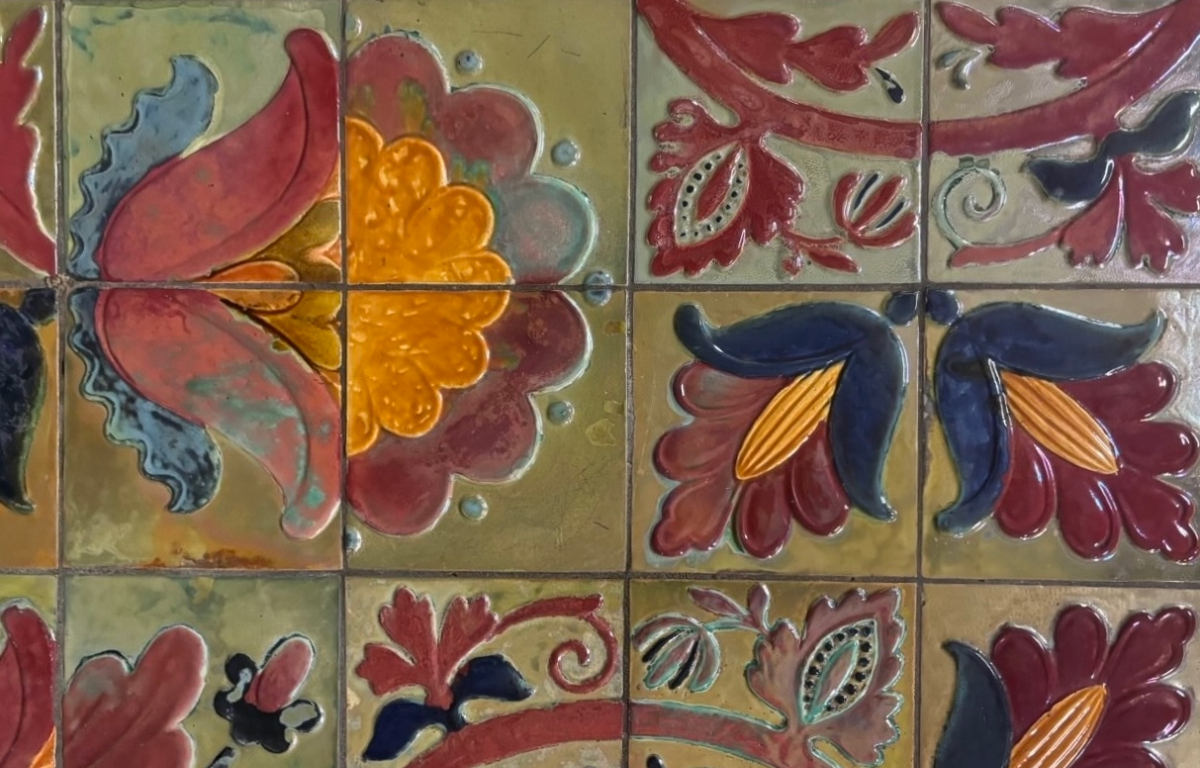
So, the Stalinist works of art are supposed to be socialist in content, and I assume that this should have worked the same way with Khreshchatyk. However, the ceramic tiles and the cake-like structure constructing this piece can be equally interpreted as manifestations of Ukrainian national, Stalinist totalitarian, Ukrainian Soviet, or something genuinely different. The ideas of Stalinism that allegedly were brought into practice, carving content through the form, are not readable anymore, and it is still a question whether they ever were. The socialist notion as content is hardly recognisable, and the people who could remember it are getting older and being replaced by later generations.
The irony of the situation is that Khreshchatyk, the child of “post-historical culture,” is nowadays inevitably looked at in the context of history. Despite the efforts of its creators, we can rightfully doubt whether it was ever “posthistorical” or a mere imprint of the time, when it was possible to take a leap of faith into the idea of “posthistory.” Nowadays, the imagination seems to be different—history is in the present, and it is the present. For instance, while re-visioning the heritage of the twentieth century, some architectural activists in Ukraine usually tend to see Stalinist heritage as a Soviet architectural heritage (compared or opposed to either the one before Soviet or current), without the need to specify the decade. After such a move, the activists tend to lean either against or for the Soviet heritage, once again opting for it as an entity. However, it does not fit modernist architecture, which represents that epoch. Due to current memory politics, Khreshchatyk is re-envisioned through the lens of overall Soviet architecture.
What kind of consensus narrative of Ukrainian history can Khreshchatyk, as a heritage of Stalinist times, represent now, as we try to fit it into our current vision of Ukraine? The tension between form and content over time becomes more evident, as all we have available for clear interpretation is the present and whatever is saved in materiality. This brings us to the frustration showcased by the third contradiction, as it gets layered on top of the first two: what exactly are the ideas used to fit Khreshchatyk into Ukrainian heritage?
Contradiction 3: Fitting the Story Into a Current Narrative
In this part, I would like to explore how activists have revised Khreshchatyk after decades of post-Stalinism. In our conversations, some activists found it to be either “in or out of tradition,” thus treating it either as a mistake of a totalitarian regime or as a pinnacle of modernity.
The terms by which Khreshchatyk was created do not fit the way one re-envisions architectural heritage these days. The vision of national continuity was brought up in conversations through an unexpected dictionary: it was tied to words like modernity and tradition in relation to Ukrainian history. Ambiguously enough, those words, when describing Khreshchatyk, became rather an emotion than a reality-bound concept for me—I can only vaguely feel the meaning of tradition and modernity in this context.
Modernity is the inherent tension at the core of Khreshchatyk’s revisioning: what is it exactly, where does this type of architecture place us temporally within modern times, and where does it place us globally? Those ideas overlap with questions of progress and development, which are crucial for today’s thinking about the nation in relation to other nations. The notion of modernity seems to be a universal point, with tradition as the second vantage point at the core of judgment.
Activist A, a person with an art background and engaged in the protection of architectural heritage, casually mentions Khreshchatyk as “a political decision that is in conflict with Kyiv…” To quote him further: “There is also an underestimation, where Kyiv is perceived through Khreshchatyk, through Maidan… the real Kyiv is Yaroslaviv Val, Velyka Zhytomyrska… Those places represent the heyday of Kyiv as a city, in the era of this capitalist economic model. We must understand that this architecture, even after 100 years, is better adapted to some modern functions than the Soviet one. It is a fact that Soviet architecture was built artificially, not based on any economic expediency, not based on any planned development” (my highlight—SK). With this statement, he ties modernity to “organic capitalism which has happened before.” One could argue with him that Stalinism, of the styles in the USSR, came the closest to previous imperial architecture, which represents capitalism for him. Yet for him, the Stalinist style is artificial and therefore does not represent Kyiv. Drawing from his words, I assume that one way of revising Khreshchatyk is to consider it as capitalistic modernity but also our tradition, as activist A puts it—thus Khreshchatyk is non-modern and does not represent Kyiv.
The following day, mid-August of 2024, as I was interviewing activist B, also an architectural preservation activist with a background in architecture, he recalled: “If earlier the Soviet buildings were built, conditionally speaking, because it was solely the personal whim of some architect, or merchant, or something similar, then here in this period the whole society realised the necessity of architecture… The main principles of modern architecture were formed during Stalinism. Modernist and Stalinist architecture reflect, for me, Ukrainian culture as there are a lot of elements from the classical decorative art: there are all sorts of sunflowers—it is unlike a blatant imitation of anything that was there before.” For Activist B, Khreshchatyk is not part of a capitalistic tradition, because it was not a demand-supply situation “not on the whim of a merchant,” and it also takes into account Ukrainian culture by adding some folk elements to the form, which activist B perceives as tradition. In Khreshchatyk, the traditions were integrated through folklore elements, while breaking with capitalism and marching forward, offering a different conception of architecture in the city, thus making it modern. In this vision, Khreshchatyk was sort of an adaptation of national tradition within a “modern” 20th century. While walking along Khreshchatyk Street, I could spot something like this at Khreshchatyk 13, in the arch in the middle of the building and its outer ornaments.
From these unintentional dialogues, we could observe that modernity and tradition are key concepts utilised for re-envisioning. Moreover, those two activists constructed modernity through different logics. In their re-envisioning, modernity and tradition are tied to the politico-economic mode of living: Soviet or capitalist, which are also seen as opposites. For activist A, tradition is embedded in economic relations that Kyiv once supposedly possessed. It seems that tradition is a national continuity as a territorially limited mode of economic organisation. Thus, tradition is about the economic organisation of a nation, which has been reflected in architecture, rather than purely in cultural markers.
In the re-envisioning of activists, pre-Soviet capitalism and Soviet socialism are two completed, homogeneous units of history that create distinct, opposing realities. As an example, nowadays, when civil society revises the Soviet Union’s heritage, there is little to no distinction between the power struggles within the epoch and what it could have meant for different social strata. This makes me want to return to the first contradiction of act and practice that merges with the third contradiction, fitting the current into the past.
To revise with better precision, I argue that it is essential to unravel the tension within the Soviet system as a power structure and its historical continuity. For instance, Velychenko, in his book Painting Nationalism and Imperialism Red, shows that there were two movements in the 1920s in Soviet Ukraine that had opposing ideas. While the Ukrainian SSR elites were mostly aligned during Stalinism, inner tensions existed between the government and the people, inter-republican relations, etc. When there is little effort to showcase the complexity of Ukrainian Soviet history in this re-envisioning, the past is all swept away by the water of time.
What Comes Out of Those Three Contradictions?
We must revise something while considering the three main contradictions described: what was carried out, what was conceived, and what we can make out of it in the present all differ. To be crude and nitpicky, where and when should folklorization be revisited as an instrument of Stalinist policy and where as a sincere expression of folk motives? As we have observed, no one can read content separately from the form. Ideas get old, and they get lost in the form. The relation between theory and practice that Yekelchyk has shown and that Groys theorised about can not be revised in a way that would create a consensus narrative about Khreshchatyk. We could observe it even among the most interested people, such as activists on the ground. We live in the context of the Russo-Ukrainian war, where modernity and tradition, however ambiguous it might sound, are both the aim to achieve and the aim to find in the past to prove the national continuity threatened by Russian aggression.
Modernity and tradition became options with a blurry content for re-envisioning Stalinist architecture and justifying or denying it a place in Ukrainian cultural heritage. After all, nation-building through revisioning architectural heritage still happens in the global frame of international politics and a race to maintain modernity, which we do not hope to win but just humbly want not to lose. For instance, it is no news that the world-recognised and respected historical continuity of a state helps advance its politics internationally. Modernity and tradition shape the idea of a national culture that needs to justify itself to the world when threatened by war. This need for justification and national continuity also emerges in the process of revisioning Khreshchatyk.
There is an inherent conundrum within the idea of Khreshchatyk: it is modern and non-modern, traditional and not. But are those concepts different if they can be switched so easily? As I noted, they can merge into each other and relate both to the Soviet and capitalistic (in this case, pre-Soviet) Kyiv. This moment of merging of seemingly opposing concepts is extensively described by Kate Brown, who shows how two towns, one in Kazakhstan and the other in Montana, which were built under different political regimes, resemble each other closely, as the city organisation is guided by the idea of labour rather than the regime or ideology. This shows the difficulty of linking any idea (content) to an architectural form. What was conceptualised by each town’s creators as radically different turns out to look the same, and vice versa. The axis of content and form is in shambles, and we, Ukrainians who are taking part in the discussion about Ukrainian history, are still in the process of negotiating what modernity is and what tradition is in a Ukrainian city. This is a question that has political stakes, as our self-narration of the Soviet period of Ukrainian history is contributing to the idea of what kind of state Ukraine is and what it deserves in international politics. The contradictions mentioned here are not something to be avoided or smoothed out, but rather to be taken into consideration.
Khreshchatyk is an important place that was rebuilt to showcase national civic patriotism and is re-envisioned in the present through the lens of Ukrainian nationhood and the place of the Stalinist epoch within it. The Russo-Ukrainian war imposes a need for re-envisioning memory politics, and civil society theorises symbolically important spaces, but Khreshchatyk is a hard place to re-envision neatly. This is partly due to the discrepancy between the form, the architecture itself, and the content and ideas accompanying the form. This is the hardship of understanding Kyiv’s central street—the previous content is no longer there. Now, we are trying to reconfigure the content that we assume was there through different concepts relying on the form. We have a canvas, and we draw a picture using oils. So here Khreshchatyk lies with its beautiful chestnut trees: a historicized “post-historical” place, a re-traditionalized modern project, and an ambiguous example of imagined Soviet architecture.
Sources
Brown, Kate. 2001. “Gridded Lives: Why Kazakhstan and Montana Are Nearly the Same Place.” The American Historical Review 106, no. 1: 17-48. https://doi.org/10.2307/2652223.
Groys, Boris. 1992. The Total Art of Stalinism: Avant-Garde, Aesthetic Dictatorship, and Beyond. Princeton, NJ: Princeton University Press.
Oliynyk, Olena. 2018. “National Originality of the Architecture of Khreshchatyk as a Unique Ensemble of the Period of Totalitarianism.” E3S Web of Conferences 33: 01039. https://doi.org/10.1051/e3sconf/20183301039.
Rudling, Odeta. “Folklore as a Visual Medium of Socialism and National Identity: The Case of the Lithuanian SSR.” In Ästhetiken des Sozialismus / Aesthetics of Socialism, 189-211. August 2018. https://doi.org/10.7788/9783412510091.189
Velychenko, Stephen. 2018. Painting Imperialism and Nationalism Red: The Ukrainian Marxist Critique of Russian Communist Rule in Ukraine, 1918-1925. Toronto: University of Toronto Press. https://doi.org/10.3138/9781442617131.
Von Hagen, Mark. 2015. “Does Ukraine Have a History?”, Slavic Review 54, no. 3, 658-673.
Yekelchyk, Serhy. 2014. Stalin’s Citizens: Everyday Politics in the Wake of Total War. Oxford: Oxford University Press.