

In February 2022, the third-year female students of the Kharkiv National Medical University were serving their pre-medical (nursing) internship in the diabetic department of one of the municipal hospitals. On February 24th, when the municipal public transport collapsed, many of them somehow commuted to the hospital to substitute for the nurses who were not able to arrive at their workplaces. This practice dragged on for another three months until public transport circulation resumed and the medical staff, living on the outskirts of the city, were able to return to their duties.
In March 2022, the Professor of Technical Sciences working at one of Kharkiv’s universities was one of the first lecturers in the city to continue delivering synchronous online classes during the full-scale Russian-Ukrainian war. Remaining in Kharkiv, she started each lecture with the phrase “The Hero City of Kharkiv is welcoming you!” (“Vas vitaie misto-heroj Kharkiv”). She had to improvise a table, assembling it from the armrests of her sofa, placed on two stools. There were two thick volumes between the stools and the armrests—her candidate and doctoral dissertations. She could not use an ordinary table to deliver her classes, because it was covering her windows, which were cracked from the bombs’ blast waves. She was giving her lectures from her apartment, because the basement of her house was closed, and there was no other technically equipped safe space for online work. A few minutes after the beginning of the lecture, she stopped her monologue with the words, “We will continue in a minute, while a rocket whizzes over my head.” The rocket flew past. The lecture continued.
In April 2022, a third-year bachelor’s student in history decided to stay in Kharkiv. She was gathering information about the vital needs of other Kharkiv residents through city chats and guiding them on where and how to solve their problems. She was searching for insulin for strangers, unaware that in a few months she would need this medicine for herself.
In July 2022, the head of the endocrinology department of one of the Kharkiv hospitals was consulting her patients in the intensive care unit, when the plant next to the hospital was destroyed by a missile attack. Dust and debris flew. Bricks rained down on the doctors’ cars parked underneath the building. While sitting at her desk, she discreetly removed her high-heeled shoe and started twisting it with her foot to calm herself. The consultation continued.
These four sketches from wartime Kharkiv depict how the thousands of civilian women remaining in the city, as thousands of others, have been living through the full-scale Russian-Ukrainian war. Each of them has been doing the impossible for their city, and yet, has been forced to justify to their relatives and friends why they are staying in Kharkiv, rather than leaving to “save themselves, their children, and the nation’s gene pool.” They are invisible heroines—forgotten and reviled. It is high time to give them a voice.
***
The beginning of the full-scale Russian-Ukrainian war has led to significant transformations in the gender landscape of Ukraine and contributed to the formation of a new gender matrix in Ukrainian society. Migration and mobilization processes largely determining the development of state-of-the-art Ukraine have further reinforced the stereotypical vision of a woman as a “berehynia,” whose only acceptable role during wartime is to “save” themselves and their children for the future prosperity of the country. The significant attention paid in public space and academic discourse to the gendered experiences of refugee women who fled their communities for their own safety and the well-being of their children often leads to the marginalization of the experiences of civilian women who remained in hot spots to live and work for the benefit of their local community, and to the denial of their role in ensuring the resilience of militarized Ukraine. The unique nature of the gendered experiences of these women, who not only face war-related threats daily but also challenge gender stereotypes and legitimize their right to remain in their places, is worth representing.
The case of wartime Kharkiv, a city whose population has dropped from more than a million to 250,000 residents during the first months of this phase of the war, is particularly telling.1
This article aims to determine the place of the experiences of civilian women who decided to remain in Kharkiv after the start of the full-scale Russian invasion of Ukraine in the gender discourse about the Russian-Ukrainian war. It reconstructs a collective (prosopographical) portrait of these women, conceptualizes their experience within the framework of a new specific model of femininity functioning in the gender landscape of contemporary Ukraine, and identifies the nature of the conflict between the representation of their experience in local discourse and the ideas about the role of civilian women in contemporary Ukrainian society in national and foreign gender-sensitive discourses about the current war.
The structure of the gender landscape of Ukrainian society is one of the crucial problematic areas studied within contemporary gender studies in Ukraine. Contemporary Ukrainian historiography operates an established typology of femininity models functioning in the national public discourse, which provides a conceptualization of the basic images of women and serves as a fundamental cognitive model for studying the gender landscape of Ukrainian society in peacetime.
According to the typology developed by Oksana Kis, the central place in the matrix of femininity models in contemporary Ukrainian society is traditionally given to the image of the “Berehynia”—a woman who is the keeper of the family, home, and traditional culture. This image emerged in the national gender discourse in the 1990s and is still considerably popular in both public and academic discourses.2 Other key models of femininity are connected with the images of “Barbie,” “Businesswoman,” and “Feminist.” The figure of Ukrainian “Barbie” is conceptualized as a woman who puts great effort into achieving and maintaining a “doll-like” appearance and is oriented toward life in an aesthetically appealing “glossy” reality.2 As Viktoriia Hupalovska argues, the image of “Businesswoman” represents a woman forced to engage in active work due to the financial circumstances in her family.3 The figure of “Feminist,” according to Daryna Korkach, embodies an idea of a woman who actively fights against gender stereotypes and advocates for expanding the horizons of women’s rights.4 Unlike the figure of “Barbie,” the images of “Businesswoman” and “Feminist” are marginalized and therefore less examined in Ukrainian gender discourse.
The beginning of the Russian-Ukrainian war and the resulting transformation of the gender landscape of Ukrainian society have fueled a surge of interest in studying the role and place of women in today’s military realities, which have been examined by Iryna Hrabovska,5 Yuliia Maslova,6 and Halyna Nikolajchuk.7
8 This approach makes it possible to move beyond the established wartime dichotomy of examining the gender experience of Ukrainian women through the models of “Warrior” versus “Refugee.” However, it still virtually reduces the value of women’s experiences not associated with the military forces and explains it only within the framework of the widely publicized image of the “Refugee.” Like previous approaches, it leaves no room for the experiences of civilian women who chose to remain and work in their communities, particularly in frontline regions.
***
For this article, I used grounded discourse analysis to work with publications in the municipal newspaper “Kharkiv News” (“Khar’kovskye yzvestyia”), which is also known as “Kharkiv Infocity” since 2023, for the period from February 24, 2022, to December 31, 2025.9 I identified 465 issues (82% of the total number of issues published within this period) touching on the problem of the experience of civilian women who remained in Kharkiv after February 24, 2022, and constructed a source complex containing 1792 units of information for further research (notes dedicated to the experiences of specific women during the war or mentioning women who remained in Kharkiv; interviews about the experience of surviving the war, conducted by newspaper correspondents with such women; portrait photographs of such women, supplementing text materials and photos from the life of Kharkiv, in which women are present). In addition, I used materials from the “Face of Kharkiv” digital project, implemented with the initiative of the Kharkiv City Council from May 2022 to July 202310 and identified 185 posts dedicated to Kharkiv civilians who remained in the city after the start of the full-scale Russian invasion of Ukraine.
***
According to the Main Statistics Department of the Kharkiv Region, in January 2022, the Kharkiv population was 1.4 million.11 From the first day of the full-scale Russian-Ukrainian war, Kharkiv has become one of the most heavily shelled cities in Ukraine and has undergone massive armed attacks almost every day. The city’s proximity to the frontline and the intense shelling have led to a rapid outflow of the city’s population to other regions of Ukraine and abroad. During the first couple of months of the full-scale war, according to data from the Kharkiv Regional Military Administration, the city’s population dropped to approximately 250,000 people,12 which, as happened nationwide, was primarily due to the exodus of women and children. The exceptionally high rate of women’s migration during the initial stages of the war (according to the Razumkov Center’s data for April 2022, they constituted 93% of the total number of Ukrainian refugees13 ) contributed to the victimization of women in public discourse about the Russian-Ukrainian war and the promotion of the image of the “Berehynia”—a woman who must “save” herself and her children from war to preserve Ukrainian national identity and culture. A woman who remained in a hot spot and worked for the benefit of her local community was marginalized in the public consciousness and positioned as nothing less than a selfish and irresponsible social element.
14 and materials from the digital project “Face of Kharkiv” (May 2022-July 2023)15 allowed me to reconstruct a collective (prosopographical) portrait of Kharkiv women who remained in the city based on their occupation and the functions they performed in the life of the city. The results of this analysis are presented in Diagrams 1 and 2.
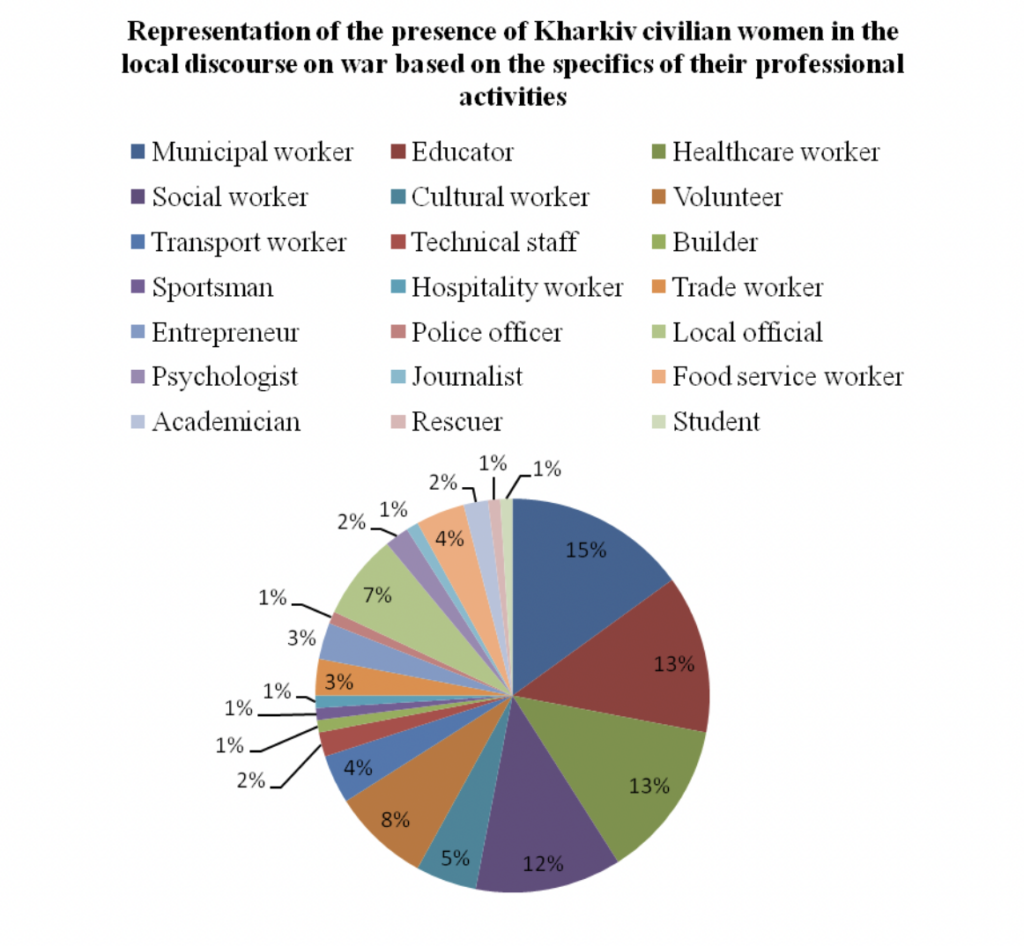
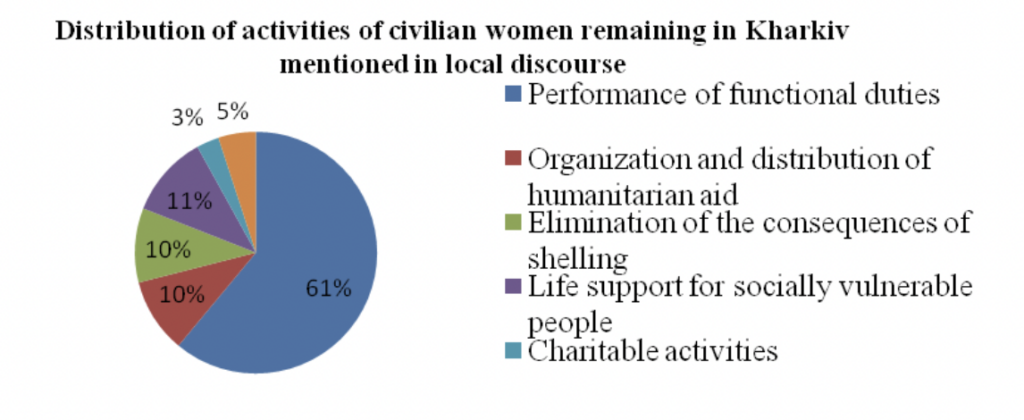
Municipal workers, educators, medical workers, and social workers, who are combining their functional duties with participation in the amelioration of the consequences of shelling, renovation of urban infrastructure, organization and distribution of humanitarian aid to vulnerable categories of the population, have become the central female figures in the local discourse about the war. The images of women representatives of volunteer organizations and local officials, whose main area of activity has become the coordination of city life support processes, are also quite noticeable.
Other significant categories of women visible in the public discourse about the war are the figures of women working in the fields of trade, public catering, and transportation, who are playing an important role in ensuring the economic development of the city; police officers and rescuers, ensuring order and safe life in the city; technical staff working at “Points of Invincibility” (specially equipped locations, primarily based on various objects of social infrastructure and equipped to meet citizens’ basic needs during emergencies), helping Kharkiv residents overcome the aftermath of shelling and blackouts; journalists, representatives of culture, science, art, and sports, working to shape Kharkiv’s image as a progressive Ukrainian city that, despite its proximity to the frontline and constant shelling, continues to thrive and develop. In contrast to this, women implementing their own projects, regardless of their focus, and advocating for initiatives aimed at improving the quality of life of residents of individual districts or the entire urban territorial community, can be defined as practically “invisible” in the local discourse about the war. This suggests that the figure of the woman who decided to stay in Kharkiv after the full-scale Russian invasion of Ukraine is depicted in local discourse as someone who plays a significant role in ensuring the homeostasis of the urban community and not seeking to act as an agent of change.
The orientation of these women, regardless of their occupation, toward participating in processes of overcoming or stabilizing crises caused by the war and significantly impacting the daily lives of their community, suggests the emergence of a new, specific model of femininity in the gender matrix of contemporary Ukrainian society that can be conceptualized by the metaphor of the “caryatid.”
Like this architectural element—a load-bearing column that supports a building—such a woman is an important actor in preserving and increasing the resilience of the local community during a period of uncertainty.
The main characteristics defining the image of the Kharkiv “caryatid” are the high level of personification of the figure of such a woman in the local public discourse about the war, and the presence of a specific value core, which has become the basis for her decision to remain in the city after February 24, 2022. An analysis of the quantitative ratio of information units reflecting various aspects of women’s experiences during the war demonstrates that 68 percent of their total number contain biographical data of heroines and/or appeal to their individual experience of surviving in the war conditions, while the other 32 percent remain impersonal, mostly presented by group photographs of employees or shots from the life of the city, in which the woman is depicted at work. The clear predominance of personalized sources suggests a high level of agency of these women in the local discourse about the war. This particular representation of the “caryatid” image clearly contrasts with the depersonalized figure of the “refugee,” central to both national and international gender-sensitive discourse about the Russian-Ukrainian war and depicted among a crowd of similar women “saving children” and seeking refuge in a new location
The key idea defining the “caryatid” model of behavior is the notion of a sense of duty to other city residents, which is absolutized in the hierarchy of values of such women, as opposed to the idea of their own well-being and the well-being of their families (particularly their children) as the highest good. The fundamental differences in the value orientations of the “caryatid” and the “berehynia,” reflected in the dichotomies of “public good versus personal security,” underlie the conflict between the local gender discourse of frontline Kharkiv and representations of the gender experiences of Ukrainian civilian women in national and international discourses about the Russian-Ukrainian war.
The typical narrative model for the war experience of Kharkiv women remaining in the city is the story of a woman who faced significant danger to her life and an extremely high level of uncertainty but made a conscious decision to remain in the city to fulfill her professional duty and help to support the livelihoods of other people. Rather paradoxical, yet clearly discernible features of these narratives are the lack of any attempt to glorify, romanticize, or tragicize their everyday experience of war; the absolute predominance of stories related to professional activities or participation in collective social initiatives; and the exceptionally low level of representation of stories touching on the heroines’ families’ experiences of war and their individual charitable or volunteer activities.
Typical speech patterns present in publications about the war experiences of Kharkiv women who remained in the city include phrases about a woman who, “like everyone else, had the opportunity to leave the city,” but remained in Kharkiv despite her personal circumstances to “work for Kharkiv residents,” thereby “holding the situation stable.” This rhetoric, traced both in materials published in municipal media and in self-narratives presented in the profiles of Kharkiv women who remained in the city, makes it possible to conclude that the core value of the “caryatid” image is based on an absolutized sense of duty to the local community, as opposed to a focus on private feelings, interests, and aspirations.
The aforementioned dichotomies of personal and public good, security and duty as fundamental values shaping women’s behavior during the Russian-Ukrainian war has become the basis for the antagonism between the femininity models of the “berehynia” fleeing war and the “caryatid” remaining to sustain the situation on her shoulders, and has shaped the discrepancy between local and national (and international) gender-sensitive discourses about the Russian-Ukrainian war.
Bibliography
1. Hlebova, N. Hlyns’ka, L., Demchyk, A. “Osoblyvosti samorealizatsii ukrains’koi zhinky v umovakh voiennoho stanu.” Ukrainoznavchyj al’manakh, Vyp. 34 (2024): 51-58.
2. Hrabovs’ka, I. “Filosofs’ko-svitohliadnyj analiz problemy ‘zhinka i vijna’ (na prykladi suchasnoi Ukrainy).” Versus, №2 (10) (2017): 50-55.
3. Hupalovs’ka, V. “Henderni determinanty sub’iektyvnoho blahopoluchchia zhinok: teoretychnyj analiz.” Sotsiohumanitarni problemy liudyny, №4 (2010): 208-223.
4. Johnson, L. “Adapting and combining constructivist grounded theory and discourse analysis: a practical guide for research.” International Journal of Multiple Research Approaches, 8, № 1 (2014): 117-133.
5. Kis, O. “Modeli konstruiuvannia hendernoi identychnosti zhinky v suchasnij Ukraini.” Y, № 27 (2003). https://www.ji.lviv.ua/n27texts/kis.htm
6. Korkach, D. “Henderni modeli ta zhinochi stratehii vyzhyvannia u period transformatsij v Ukraini u 1990-ti rr.” Hileia, № 153 (2020): 66-70.
7. Kovalenko, Yu. “Obrazy suchasnykh zhinok v ukrains’komu suspil’stvi.” Sotsial’ni tekhnolohii: aktual’ni problemy teorii ta praktyky, № 65-66 (2015): 96-102.
8. Mackenzie, J. “Grounded discourse analysis: a new hybrid methodology.” CADAAD Journal 17, № 6 (2025):1-18. https://doi.org/10.21827/cadaad.17.2.42199
9. Maslova, Yu. “Modeli hendernoi identychnosti zhinky v suchasnij Ukraini (na materialakh drukovanykh ZMI).” V Aktual’ni pytannia humanitarnykh nauk: mizhvuzivs’kyj zbirnyk naukovykh prats’ molodykh vchenykh Drohobyts’koho derzhavnoho pedahohichnoho universytetu imeni Ivana Franka, red. M. Pantiuk, A. Dushnyj, I. Zymomria. Vydavnychyj dim “Hel’vetyka,” 2020.
10. Maslova, Yu. “Obraz zhinky v suchasnomu hazetnomu dyskursi Ukrainy voiennoho periodu.” Naukovi zapysky Natsional’noho universytetu «Ostroz’ka akademiia»: seriia «Filolohiia», № 21(89) (2024): 134-138.
11. Nikolajchuk, H. “Transformatsiia zhinochykh rolej v umovakh vijny.” Psykholohiia: real’nist’ ta perspektyvy. Vyp. 24 (2025): 99-105.
12. Orlova, T. “Mifolohema ‘Berehyni’ v svitli krytyky ukrains’kykh suspil’svoznavtsiv.” Storinky istorii, № 31 (2010): 2015-213.13. Pokul’, O. “Evoliutsiia obrazu zhinky-berehyni u vymiri ukrains’koi postmodernoi kul’tury.” Visnyk LNAM. Seriia: Kul’turolohiia, Vyp. 29 (2016): 130-140.
- Halyna Hrebeniuk, “U Kharkovi kozhen shostyj—pereselenets’: skil’ky liudej zhyve u misti zaraz,” Slobids’kyj kraj, October 14, 2025, https://www.slk.kh.ua/oblast-online/harkiv/terehov-povidomiv-skilki-ludej-nini-meskae-u-harkovi.html [↩]
- Oksana Kis,“Modeli konstruiuvannia hendernoi identychnosti zhinky v suchasnij Ukraini,” Y, № 27 (2003), https://www.ji.lviv.ua/n27texts/kis.htm [↩] [↩]
- Victoriia Hupalovs’ka., “Henderni determinanty sub’iektyvnoho blahopoluchchia zhinok: teoretychnyj analiz,” Sotsiohumanitarni problemy liudyny, №4 (2010): 208-223. [↩]
- Daryna Korkach, “Henderni modeli ta zhinochi stratehii vyzhyvannia u period transformatsij v Ukraini u 1990-ti rr.,” Hileia, № 153 (2020): 66-70. [↩]
- Iryna Hrabovs’ka., “Filosofs’ko-svitohliadnyj analiz problemy ‘zhinka i vijna’ (na prykladi suchasnoi Ukrainy),” Versus, №2 (10) (2017): 50-55. [↩]
- Yuliia Maslova, “Modeli hendernoi identychnosti zhinky v suchasnij Ukraini (na materialakh drukovanykh ZMI).” V Aktual’ni pytannia humanitarnykh nauk: mizhvuzivs’kyj zbirnyk naukovykh prats’ molodykh vchenykh Drohobyts’koho derzhavnoho pedahohichnoho universytetu imeni Ivana Franka, red. M. Pantiuk, A. Dushnyj, I. Zymomria. Vydavnychyj dim “Hel’vetyka,” 2020. [↩]
- Halyna Nikolajchuk, “Transformatsiia zhinochykh rolej v umovakh vijny,” Psykholohiia: real’nist’ ta perspektyvy. Vyp. 24 (2025): 99-105. [↩]
- 1vw - 3.2px) * 0.313), 18px);">One of the significant manifestations of this process is an activation of attempts to design a new typology of femininity models reflecting the specific gender experiences of different categories of Ukrainian women during the Russian invasion of Ukraine.
The most comprehensive approach to this problem was proposed by Nataliia Glebova, Liudmila Glinskaya, and Oleksandr Demchik, who conceptualized such key models of femininity as “Warrior” (a woman serving in the Armed Forces of Ukraine or in the Territorial Defense Forces), “Paramedic” (a female medic voluntarily serving near the frontlines), “Volunteer” (a woman primarily engaged in active assistance to the military forces), and “Refugee” (a woman forced to flee from the war to other regions or abroad to “save” her children). ((Hlebova, N., Hlyns’ka, L., Demchyk, A., “Osoblyvosti samorealizatsii ukrains’koi zhinky v umovakh voiennoho stanu,” Ukrainoznavchyj al’manakh, Vyp. 34 (2024): 51-58. [↩]
- Komunal’ne pidpryiemstvo “Infositi” Kharkivs’koi mis’koi rady. “Hazeta.” Accessed January 10. 2026. https://infocity.kharkiv.ua/gazeta/ [↩]
- Kharkivs’ka mis’ka rada. “Oblychchia Kharkova” Accessed January 10. 2026. https://city.kharkiv.ua/news/obliccia-xarkova [↩]
- Holovne upravlinnia statystyky u Kharkivs’kij oblasti. “Arkhiv. Chysel’nist’ naselennia (za otsinkoiu) na 1 sichnia 2022 roku ta serednia chysel’nist’ u 2021 rotsi.” Accessed November, 30. 2025. https://kh.ukrstat.gov.ua/2022chiselnasel/4303 [↩]
- Hrebeniuk, Halyna. “U Kharkovi kozhen shostyj—pereselenets’: skil’ky liudej zhyve u misti zaraz,” Slobids’kyj kraj, October 14, 2025. https://www.slk.kh.ua/oblast-online/harkiv/terehov-povidomiv-skilki-ludej-nini-meskae-u-harkovi.html [↩]
- Mischenko, Mykhajlo. “Bizhentsi: shtrykhy do portretu,” Razumkov Tsentr. Accessed November, 30. 2025. https://razumkov.org.ua/statti/bizhentsi-shtrykhy-do-portretu [↩]
- 1vw - 3.2px) * 0.313), 18px);">The pronounced negative assessment of the image of such women in the public consciousness led to their de-subjectification and determined their subsequent “invisibility” in the national gender discourse about the Russian-Ukrainian war.
Despite marginalization at the national level, the figure of the woman who remained to live and work in Kharkiv became central in the local discourse about the Russian-Ukrainian war. An analysis of publications published in the municipal newspaper Kharkivskie Izvestiya between February 24, 2022 and December 31, 2025, ((Komunal’ne pidpryiemstvo “Infositi” Kharkivs’koi mis’koi rady. “Hazeta.” Accessed January 10. 2026. https://infocity.kharkiv.ua/gazeta/ [↩]
- Kharkivs’ka mis’ka rada. “Oblychchia Kharkova.” Accessed January 10. 2026. https://city.kharkiv.ua/news/obliccia-xarkova [↩]