
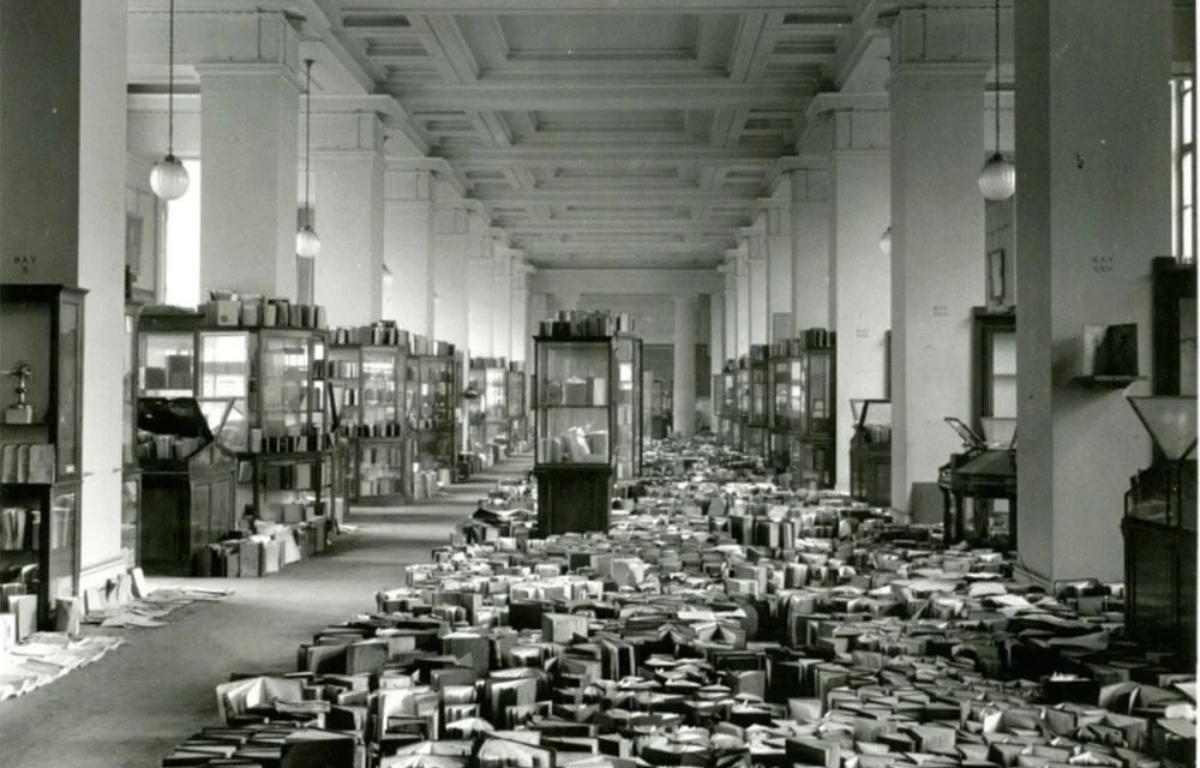
The article explores how museums in Soviet Ukraine during the 1920s and the 1930s contributed to the spread of Communist propaganda. It examines this issue through the example of the Museum of the Revolution of the UkrSSR (Kharkiv), which operated under the direct leadership of the Communist Party structures. Materials from the Letopis’ revolyutsii / Litopys revoliutsii (The Chronicle of the Revolution) journal help reconstruct museum activities.
“This condensed history of the revolutionary struggle brings many, especially youths, to an ecstasy, causing them to swear promises to continue the struggle begun by the Communist Party until the end,”1 stated M. Ivanov, head of the All-Ukrainian Istpart, a commission for researching the materials about the history of the October Revolution.2 He was reflecting on the impressions from the Istpart exhibition about the Thirtieth Anniversary of the All-Union Communist Party of the Bolsheviks (AUCPB) in Kharkiv, which served as the capital of Soviet Ukraine from 1919 to 1934. The Istpart exhibitions became the foundation of the Museum of the Revolution of the USSR in subsequent years.
Bolsheviks began collecting materials on the history of the revolution in 1918, starting in Russia.3 The significant leap in the development of the museums of the revolution occurred in 1927 because of the tenth anniversary of the “Great October” celebrations and the growing political engagement of museums in general. The museums of the revolution were supposed to play a crucial role in political and educational objectives, such as legitimizing the authorities by demonstrating their connections to the past and emphasizing the longue durée of revolutionary history,4 sometimes tracing its roots back to the seventeenth century. The opportunity to see artifacts related to historical events was supposed to have a strong educational effect. Overall, during the 1920s and the 1930s, the museums of the revolution played the role of “mediators between politics and the population,”5 showcasing how the authorities perceived themselves.
This article aims to show how cultural and educational institutions were utilized for party propaganda, exploring what opportunities for influence they had and how they used them. The political and educational role of museums during the 1920s and the 1930s is still not sufficiently explored, though it was a special period in the museums’ development in the Soviet Union in general. This period encompassed not only personnel changes but also methodological ones: while earlier a lot of museums had positioned themselves as scientific institutions, authorities later expected them to focus more on the educational work.6 As a case study, I considered the Museum of the Revolution of the UkrSSR (Ukrainian Socialist Soviet Republic, Kharkiv), which worked under the auspices of the Istpart. Framing this analysis, I employ the definition of propaganda by Peter Kenez: “the attempt to transmit social and political values in the hope of influencing people’s thinking, emotions, and thereby behavior.”7
During the 1920s and the early 1930s, such propaganda was not exclusively imposed from above; many prominent Ukrainian writers and artists admired the social changes brought about by the Bolsheviks, supporting them in their works. Moreover, the Communist Party played a significant role in their career advancement, as it was with Mykola Kulish and Mykola Khvylovyi.8 In the years 1925–1928, Khvylovyi initiated a huge literary discussion, which quickly left the framework of artistic research and turned into political debates.9 At the beginning of the discussion, Khvylovyi declared his literary path to be in accordance with Marxist ideology. Closer to the end of the 1920s, his main theses, such as an orientation towards the intellectual reader and an appeal to European literature as opposed to Russian, became politically unacceptable. The discussion turned to the issue of national oppression, which contradicted the Party’s search for “friendship of peoples.” Khvylovyi and his circle—whose central figures were the writers Mykhailo Yalovyi and Oles Dosvitnii—were labeled as hostile to the Soviet authorities. Oleksandr Shumskyi, Khvylovyi’s patron in the government, lost influence because of his so-called “national bias.” The writer committed suicide, disappointed by the practical implementation of communist ideals.10
According to Kenez, the goal for socialist revolutionaries was to “bring the fruits of the Marxist analysis to the proletariat,” and the Communist Party had to play a key role in this process. Political education in this sense was equated with propaganda.11 Museums also played a significant role in this effort. Museums were thought to solve two essential tasks of the political-educational system: educate a party nomenclature and construct “the socialist human being.”12 For example, the Museum of the Revolution of the UkrSSR actively cooperated with party schools by giving tours to their students. Guided tours and other educational events for pupils, soldiers, workers, and peasants were supposed to help educate and mold loyal Soviet citizens.
Such priorities were also displayed in public. In 1925–1926, a discussion took place between the Republican Administration of Scientific Institutions (Ukrnauka) and the Republican Political and Educational Committee (Ukrpolitosvita)13 about museum policy in Soviet Ukraine.14 As a result, museums under the People’s Commissariat of Education went under Ukrnauka authority but were managed by Mykhailo Kryvorotchenko, who represented Ukrpolitosvita earlier.15 He emphasized that the entire educational policy of the Soviet authorities was directed at “the formation of politically literate, conscious citizens of the Soviet republic” and the formation of skilled workers in all fields. He also considered museums to be one of the bases of political, professional, social, and scientific educational work.16
The links between the cultural sphere, of which museums are a part, and political propaganda in the 1920s and 1930s require an in-depth analysis, particularly regarding the influence of propaganda on art and literature. Myroslav Shkandrij, in his book Avant-Garde Art in Ukraine, 1910–1930. A Memory Worth Fighting For, characterized 1920–28 as a period of artistic experimentation, political turmoil, and debate.17 This period was characterized by a lack of clear distinction between the political and cultural realms. In the 1930s, the social function of literature and various arts became extremely important. This meant that the artists more and more actively tried to influence people’s behavior in accordance with current politics, willingly and not.18 The authorities, in turn, expected such behavior from artists and writers. In 1928, the Central Executive Committee and the People’s Commissariat of Education of the USSR issued a resolution, according to which museums were expected to play a more active role in agitative campaigns by creating exhibitions promoting state policies.19 In the case of the Museum of the Revolution of the UkrSSR, these policies were connected with the collectivization and historical narratives on the revolutionary movements.
The Istpart’s Letopis’ revolyutsii journal (Litopys revoliutsii since 1928) became the primary source for this research. It was an official media organ of the Istpart, published from 1922 to 1933 in Kharkiv. On average, it was published once a quarter, but it did not always adhere to this periodicity. Circulation did not change so much. There were 5,000 copies in 192320 and 6,150 in 1931.21 It was important as a medium in which the officially approved view on revolutionary history was published. Its authors primarily published articles, memoirs, and documents about the establishment of Soviet authority in Ukraine and about revolutionary movements in the 19th–20th centuries. The Istpart often reported about its activities, mentioning the Museum of the Revolution. These materials reflected reality as the Communist Party wanted it to be. Consequently, the authenticity of published visitors’ feedback is questionable. However, the articles from this journal help us to understand its main activities. Documents from the Institute of Manuscripts of V.I. Vernadsky National Library of Ukraine (IM NLU) added details to the general picture. Newspapers with rare news about the museum and questionnaires with information about the museum’s work sent in response to a survey by the Museum of Ukrainian Scientists and Artists (Kyiv) are among them.
To contextualize my research, I incorporated ideas from the monographs of Stefan Plaggenborg22 and Francine Hirsh.23 Both authors examine cultural changes in the Soviet Union in the 1920s and the 1930s, presenting museums within the context of social and political activities. Serhy Yekelchyk24 highlighted the role of history and policy of memory in Soviet Ukraine during Stalin’s epoch. He emphasizes that despite increasing centralization, local authorities had some space for agency. Articles by Anna Yanenko,25 Vitaly Kushnir,26 and Oleksandr Bon’27 provide information that helps us to systematize museum life in the 1920s–1930s and look at it from unusual angles, for example, by analyzing gossip. Oksana Klymenko28 provides a wide view on the methodology used by the Istpart in collecting memories of workers about industrialization victories. This helps us to better understand the Istpart’s actions for memorializing recent events.
In the first section of this article, I will explore the general information about the Museum of the Revolution, including its establishment, its staff and collections, and the challenges it faced. In the second section, I will analyze its working formats, primarily through the lens of its permanent and traveling exhibitions.
Establishing the Museum
The Museum of the Revolution of the UkrSSR was established in the first half of the 1920s. One of the first mentions of plans to organize it can be found in the Letopis’ revolyutsii in 1923. An unknown author wrote that the exhibition about the history of the revolutionary movement and the All-Union Communist Party (Bolsheviks; AUCPB) could be transformed into a permanent museum of the revolution, expanding its exposition.29 Political education had to be at the heart of the future museum’s work, as its tasks were described as “service” for party congresses, guided tours for workers organized by communist cells and trade unions, tours for Red Army soldiers, and party schools, which prepared party agitators and leaders of Soviet and party work in general.30 The museum also had to function as a library for the lecturers and people researching the Party’s history. The Istpart suggested the commemorative evenings as an effective way to involve the public in the museum’s work.31 During these meetings, people often shared memories about revolutionary events; these were prepared in advance and approved by organizers from Istpart’s organizations.32 These testimonies created an acceptable narrative for the Bolshevik authorities.
In 1925, the Istpart exhibition was turned into the Museum of the Revolution of the UkrSSR.33 Although its development was fairly rapid, the quality of the exhibitions and its activities is difficult to evaluate solely through the quantitative indicators I have identified. Initially, it had five employees and a 6,960 ruble annual budget. But less than a year later, the museum had 14 employees and a 20,000 ruble budget.34 With this new status, the collection began to grow rapidly, reaching 3,289 pieces of illustrative materials in March 1925 and 8,435 such items at the beginning of 1926. However, there were 118 “material exhibits” including weapons, flags, and seals. The museum consisted of departments devoted to such topics as populism and the first workers’ circles; the revolution of 1905; reaction, the “imperialist war” (the official Soviet name for World War I) and the February Revolution in 1917; the October Revolution of 1917; and the civil war in Ukraine.35 Primarily, the museum focused on the Bolshevik Revolution as a whole, placing special emphasis on the materials about Ukraine. For comparison, the museum in Kharkiv stored more than 26,000 items by 1926, while the Museum of the Revolution of the USSR in Moscow had 24,000 items, and the Museum of the Revolution in Leningrad had about 22,000 objects.36 It is important to understand the quality of these objects more fully, including how unique and attractive they were to visitors.
The number of visitors increased significantly. A great leap was made in 1925: 23,705 visitors per year, compared to 9,945 in 1924.37 At the beginning of 1926, there were 900–1,100 museumgoers each Sunday, the same number of visits the museum received per month and a half in 1923. At the jubilee exhibition in 1927, the largest category of visitors was workers (33 %), then officials (25 %), quite a lot of pupils (20 %), military personnel (11 %), peasants (7 %), and “others” (4 %). There were 31 % Party and Komsomol members among the museumgoers. Groups from professional and seven-year schools, from universities, and so on visited the museum for better learning.38 “The Museum of the Revolution is acquiring the role of the mass political school,” claimed G. F. Slobodskyi, director of the museum.39) From the visitors’ perspective, the unnamed cadet gave this definition for the organization: “The museum is a book of the revolution, which even the illiterate can read.”40 A noteworthy observation, considering that in the early 1920s, the Soviet state was actively engaged in eliminating illiteracy among the people.
In general, museums became increasingly propagandistic in the second half of the 1920s, simultaneously attracting more visitors. Stefan Plaggenborg noted that 21 million people visited Soviet museums in 1935, accounting for 12.7 % of the population.41 According to Plaggenborg, most of these visits were group ones, whereas in the early 1920s, people more often went to museums individually, which could be interpreted as more voluntary visits. On the other hand, the Istpart representatives complained about the lack of group visits to the stationary museum exhibition in 1928, noting that there were only 20 % of the total amount.42 Of course, visiting such exhibitions could be interpreted as part of the life of a loyal Soviet citizen. But the fact that, at least in the late 1920s, the museum exhibition was mostly visited individually indicates interest in the museum’s work among the people.
For a long time, the museum lacked a permanent location, despite its representatives mentioning this problem ten times at least at the Presidium of the All-Ukrainian Central Executive Committee (AUCEC). In 1928, some authority structures moved to the House of State Industry (known as Derzhprom). They vacated the buildings where they had worked previously, and the Central Committee of the Communist Party (Bolsheviks) of Ukraine (CPBU) promised to give one of them to the Museum. But a dispute arose over these vacant buildings, and the interests of the museum were forgotten.43 I did not find information about the first location of the museum, but its first exhibition was situated in the place where the 7th All-Ukrainian Congress of Soviets was held.44 From the second half of 1928, the museum had only one permanent exhibition: “The October Revolution and the Civil War in Ukraine,” situated definitively at the temporarily provided premises of the Artem All-Ukrainian Socialist Museum.45
On September 24, 1931, the reorganization of the Museum of the Revolution began.46 The respective decree of the AUCEC appeared on June 20, 1932.47 Although Soviet museums generally emphasized educational activities, this museum was regarded as a research institution. It had to study, show, and popularize the history of the proletarian revolution and the history of the CPU, the AUCPB, and the international Communist movement. This change in priorities and renaming to the All-Ukrainian Central Museum of the Revolution looked important in the context of Ukrainization, with its growing attention to the local context. The museum about revolutionary history in the UkrSSR became just All-Ukrainian, with the management of local museums of the revolution added to its responsibilities.48 This change occurred when the policy of Ukrainization was already nearing completion. This may indicate that the museum was not very focused on it. On the other hand, it shows that certain manifestations of Ukrainization may have already occurred in the final stages of this policy. I did not find precise information about the languages used in the museum exhibitions, but the Istpart’s journal was renamed in Ukrainian as Litopys revoliutsii in 1928 and published texts in both Ukrainian and Russian. In 1930, the magazine was published entirely in Ukrainian. A similar situation could have occurred with the museum exhibitions, which were also Istpart projects.
The official start of the korenizatsiia policy is associated with the XII Congress of the Russian Communist Party of the Bolsheviks on April 17–25, 1923, proclaiming the course for the elimination of inequality between different nationalities. The main goal of korenizatsiia was to make Soviet narratives familiar to different nationalities, using their native languages.49 In Soviet Ukraine, this process started in an uneasy atmosphere. Many Bolsheviks perceived Ukrainian culture as inferior. In 1919–1923, the theory of “the battle of two cultures” gained widespread popularity. The theory, formulated by Dmytro Lebed’, conceptualized the conflict between Russian highbrow “urban culture” and Ukrainian lowbrow “rural culture.”50 Lebed’ considered Ukrainization impractical, because it meant the forced imposition of the rural language on the Russian-speaking proletariat. According to this approach, Ukrainian could only be used for education in the countryside, to prepare people for the transition to the Russian language and culture.51 Hence, the strongest had to win, and many Communists from Ukraine bet on Russian culture. But in 1923, the young Soviet state was looking for ways to make different regions, especially the border regions, more stable and loyal.
The korenizatsiia period is characterized by the development of propaganda materials aimed at making the narratives of the authorities understandable to the local communities in a variety of formats: exhibitions, films, and literary works of various genres. In his field-establishing book, Terry Martin argues that the Soviet authorities were quite sincere in their desire to help local cultures with their development, which seems contradictory.52
The museum had to work under the auspices of the Presidium of the AUCEC.53 The Istpart was responsible for its ideological management. The museum received state funding from the budget of the AUCEC.54 The Presidium of the AUCEC appointed the director of the museum,55 who in turn selected his assistants to manage three areas of work: scientific research, local museums of the revolution, and financial matters. An advisory board, which included assistants and representatives from the Istpart and the old Bolsheviks society, supported the director.
Even for the museum staff, it was difficult to list their employees during the first ten years of work. The report from 1933 mentions only ten researchers, who worked at the museum at that time, and the directors: Yevheniia Adamovych, the organizer and the director of the museum (1922–1924, 1931–1933), G. F. Slobodskyi, director in 1924–1929, and K. M. Gol’bert, director in 1930.56 Yevheniia Adamovych, the author of this report, attributes this to a lack of special employee records and a high staff turnover.
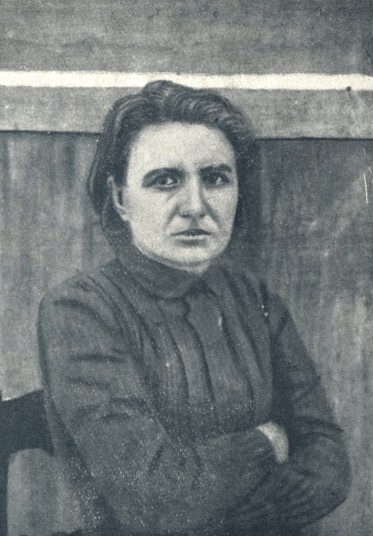
Yevheniia Adamovych (Photo 1), one of the key persons at the museum, was a prominent “old Bolshevik lady.”57 According to a short article in the biobibliographic dictionary about figures of the revolutionary movement in Russia, Yevheniia Adamovych was born into a petty noble family in Khoroly county, Poltava region in 1872. Her father was a landowner. Yevheniia studied at the Kremenchuk gymnasium and graduated from obstetrics courses in Yuryev (Tartu, Estonia today). There she joined a Marxist circle58 and came under police surveillance shortly after. At the end of the 1890s, Adamovych went to Moscow, where she worked in the social democratic organization. She was arrested for agitation among the workers. After six months of imprisonment, she was exiled to Katerynoslav (today’s Dnipro). Yevheniia joined the Bolsheviks in the early 1900s in Petersburg.59 She lived through the years leading up to the October Revolution, engaging in political activities across various cities in Russia and Ukraine. Her experiences included arrests, exiles, and constant police surveillance. Yevheniia met the February Revolution in the imperial capital, at a police station, from where she was released. During the October Revolution, Adamovych worked in the pass bureau in Smolny,60 and later at the People’s Commissariat of Education. In 1919, Adamovych came back to Ukraine, where she started to work at the Istpart. Behind the organizational work, she wrote memoirs about Lenin61 and articles about Bolshevik activities in Ukraine.62
The story of Yevheniia Adamovych illustrates what internal transnationalism can be like. This concept is important to Mayhill Fowler and Olena Palko, who employed it in writing about cultural changes in Ukraine during korenizatsiia.63 In this case, it means “the exchange of peoples, goods, and ideas across the real–and imagined–borders inside the Soviet Union.”64 Mayhill Fowler discussed it in the context of relations in theatrical and literary circles in the Soviet Union and particularly in Soviet Ukraine. It also gives an additional perspective on the organizational peculiarities of Ukrainian museums, as their employees made working trips to Soviet Russia, corresponding with colleagues in other republics.65 Yevheniia Adamovych was born in Ukraine, when it was part of the Russian Empire. She developed a museum in Ukraine, and it seems that she was more of a Russian representative. Adamovych knew the local context when discussing revolutionary events, and she should have been a reliable figure for the authorities, particularly in Soviet Russia.
Available sources do not provide information on how Yevheniia Adamovych identified herself. She was perceived as a Russian revolutionary, known in the highest circles of power. However, it is highly probable that such an identification was not imposed from outside, but corresponded with her own self-image. After gaining recognition, she returned to her small homeland, presumably to participate in implementing the center’s policies there. It is unknown how her life ended. There are some indications that she died in 1938,66 which could be connected with the Great Terror, when a lot of old Bolsheviks were executed. The Central State Archive of Public Associations and Ukrainian Studies, State Archive Branch of the Security Service of Ukraine, and its department in Poltava oblast do not have any information about Yevheniia Adamovych. So, to this day, the biography of the museum’s key organizer still contains many blank spots.
The Museum of the Revolution of the UkrSSR was established in the middle of the 1920s, when political work among the people was intensifying. While the organization was assigned to carry out public engagement, its scientific role remained important. The museum’s research function could be related to the fact that the correct narrative for the authorities on the history of the Communist Party was still to be developed. In 1931, the organization was renamed the All-Ukrainian Central Museum of the Revolution. This title could have been chosen under the influence of Ukrainization, which aimed to declaratively strengthen the role of local nationalities.
The Museum Activities
The first exhibition of the Museum of the Revolution of the UkrSSR was devoted to the 7th All-Ukrainian Congress of Soviets67 in December 1922. There were more than 2,500 exhibits: newspapers, photos, portraits, diagrams, posters, etc. The exhibition aimed to demonstrate the formation and development of the political circle that transitioned from the Social-Democratic Party to the governing Communist Party and finally to the Third International as the international workers’ party.68 A large part of the exhibition was devoted to the history of the Russian Communist Party, but it also included sections about the CPBU and the October Revolution in Ukraine.69 The exhibition continued to work after the congress, opening two evenings a week and on Sunday afternoons.70 There were so many groups on Sundays that sometimes, organizers had to refuse entry.
The lack of people who could professionally conduct the tour prevented growth in the number of visits. At first, the Istpart employees had to refrain from campaigning for exhibition visits at plants, because they were afraid of not being able to cope with the flow of visitors.71 The Istpart made efforts to prepare a professional guide who could deliver lectures on party history and the revolution movement “from Sten’ka Razin to the Comintern.”72 Quite often, a leader of the visitors’ group got acquainted with the exhibition before the excursion and then made an unprofessional guided tour. Museum director Yevheniia Adamovych claimed that such guides were “not only imperfect, but often very bad.”70 Complaints about the lack of professional museum guides persisted into 1928, indicating a systemic problem.73
The celebration of the 10th anniversary of the October Revolution was an important point in the museum sphere, in particular for the recently established Museum of the Revolution of the UkrSSR. Soviet Ukraine had to prepare for the anniversary with limited funding,74 and special exhibitions proved to be a cost-effective way to remind people of the country’s revolutionary history. In 1926, the Presidium of AUCEC agreed to allocate 12,000 rubles for the jubilee exhibition in the Museum of the Revolution.75 Throughout 1927, the museum’s efforts were focused on this project, in particular on acquiring new exhibits. Museum staff obtained 986 new items,76 leading to a total of 2,528 items at the exhibition.38 Most of these exhibits were on paper, including photos, posters, leaflets, newspapers, and diagrams. However, the exhibition also encompassed objects, namely Soviet and counterrevolutionary banners, weapons of the different Bolshevik enemies, seals, and a collection of bread substitutes from the famine of 1921–1923.77 Some items were donated to the museum, while others were bought. Some of the materials were received from Kharkiv enterprises.76 The organization also exchanged exhibits with the museums of the revolution in other cities; however, I could not find information on whether it did so for the jubilee project. Its employees travelled to obtain the objects both to Ukrainian cities (Kyiv, Artemivsk/Bakhmut today, etc.) and Russian ones (Moscow). The museum selected exhibits for other museums of the revolution in Kyiv, Stalino (Donetsk today), Moscow, and even for an exhibition in Cologne.78
The exhibition consisted of two main parts: the February and October Revolutions in 1917 and the civil war in Ukraine.77 The first part contained materials about both Russia and Ukraine, despite organizers’ complaints about difficulties in finding items related to events happening in Ukraine.76 Despite their limited budget, the organizers strove to experiment with formats, presenting topics dedicated to the everyday life of the revolutionary period, not just to Party history.
This anniversary exhibition was continued into 1928, which was officially explained by its success, particularly among visitors, and its overall importance. Some items were replaced with more interesting museum acquisitions.79 There were 75,708 visitors from January 1, 1928, until December 15, which is three times more than in 1926 and 1927.80 Some schools perceived this exhibition as a visual educational guide: they signed up for monthly visits and used its materials as a visual aid for classes. According to Francine Hirsch, in the first part of the 1930s, the role of museum visitors in the USSR became more proactive.81 Litopys revoliutsii has published impressions that could demonstrate how visitors of the Museum of the Revolution reacted to the exhibitions. The authenticity of these impressions published in the official magazine of the Communist Party institution raises great doubts, but it demonstrates how the authorities expected the museum to be perceived.
Noticeably, summing up the exhibition to the tenth anniversary of the October Revolution, the Istpart journal cited the feedback from foreign workers. Visitors from Germany wrote that documents from the museum prove that “liberation from capitalist slavery is possible only through the unshakable dictatorship of the working class.”82 American workers wrote that they returned to the USA to fight “for the recognition of the Soviet Union and against interference in its internal affairs.”82 These excursions for foreign workers were a part of the propagandistic work among such specialists who helped to develop the Soviet industry at that time. Perhaps the museum was an obligatory place to visit for foreign workers, as they had to know about official state policy. It is unclear how their impressions were collected or if they were real at all. But such publications could make the reader feel that life in the Soviet Union was progressing, and even foreigners from “bourgeois” countries liked this. Authorities could also see that the museum was doing its job well.
The museum was also engaged in publishing. On the occasion of the tenth anniversary of the “Great October,” it published an illustrated album, “The October Revolution and the Civil War in Ukraine,” and a series of 12 posters devoted to the same theme.38 These materials were likely published by “Derzhavne vydavnytstvo Ukrainy” (the State Publishing House of Ukraine) in Kharkiv, which was also responsible for printing Litopys revoliutsii. This task was part of the Istpart’s publishing plans, so such printed production could be distributed beyond the museum, at the republic level.
In 1928, the museum created a large project with a travelling exhibition devoted to the 30th anniversary of the AUCPB, the 10th anniversary of the CPBU, and the 25th anniversary of the Second Congress of the Russian Social Democratic Labor Party.83 Forty posters84 with photocopies of museum materials included information about both the AUCPB and CPBU. This theme, like the previous ones, showed that Russian issues remained important for the museum. On the other hand, organizers noticed that materials about the revolution in Ukraine took up a large portion of the project.85
During that time, there were ongoing discussions about the advisability of studying the history of the CPBU. Mykola Skrypnyk, the Ukrainian SSR’s People’s Commissar for Education, mentioned that some people viewed it as a nationalistic practice and suggested that learning about the history of the AUCPB, particularly in Ukraine, would suffice. However, Skrypnyk condemned this approach and labeled it “dribnoburzhuaznyi kosmopolityzm” (petty-bourgeois cosmopolitanism).On the other hand, Skrypnyk cautioned against nationalist biases in the study of Bolshevik history.86 Perhaps he tried to find some “middle way.” In practice, this meant supporting the use of the Ukrainian language in official documents and sources, such as the Litopys revoliutsii. Mykola Skrypnyk generally limited himself to slogans such as “it is necessary to ensure a Leninist-Marxist study of our past.”87
After an initial exhibition in Kharkiv, the project dedicated to the party anniversaries was shown in 45 industrial towns, primarily in the Donbas.88 The organizers mentioned the lack of local material as one of the exhibition’s shortcomings,89 a typical problem for museum projects. In each location, people had 2–3 days to see the exhibition,90 which sometimes was not enough.89 More than 101,000 visitors saw the project over its six and a half months.91 The organizers felt the lack of “propagandists-guides” in various towns.89 The exhibition was more popular in small towns, where people had fewer forms of entertainment.92 Primarily, the exposition was visited by organized guided groups of workers, Red Army soldiers, and pupils. Some groups came to the exhibition by train, truck, or on foot, covering more than ten kilometers. Such practices may indicate that the museum was an important part of educating citizens about politics, and perhaps even disciplining them. Also, the project was shown at retraining courses for party activists and propagandists, for example, in Dnipropetrovsk (Dnipro today) or Poltava. However, S. Rozyn, the author of an article about the exhibition in Litopys revoliutsii, emphasized that the Party and Komsomol organizations did not make enough use of this project. In his opinion, such exhibitions can play an important role in political education by facilitating understanding of the material in books.93
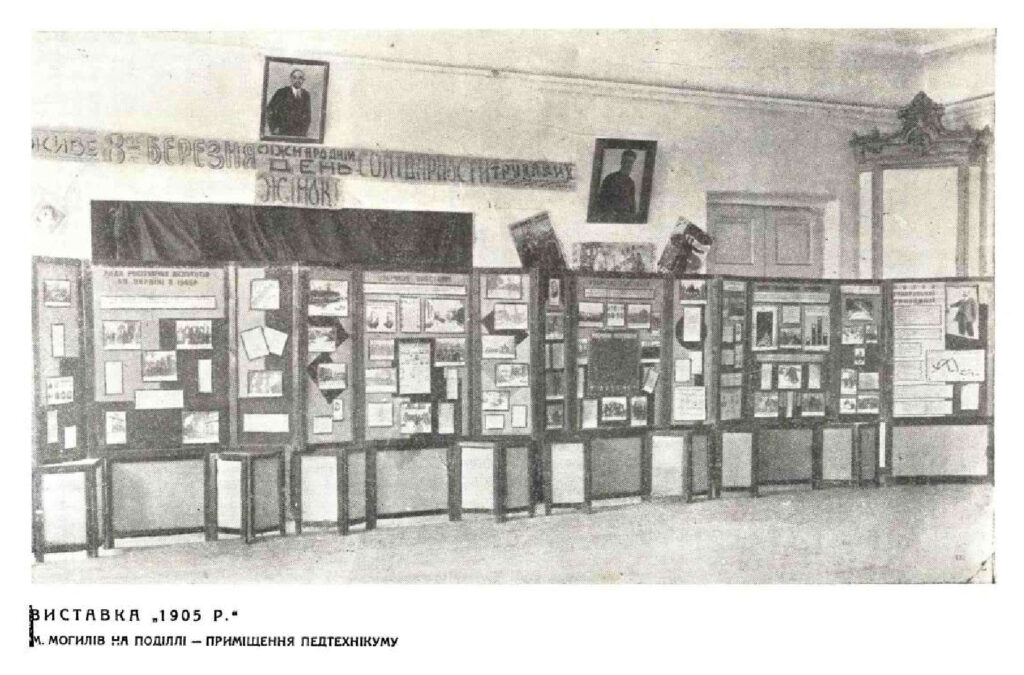
In the early 1930s, the Museum of the Revolution “shifted the focus of its activities to bringing work closer to the masses.”48 For example, the travelling exhibition “1905 on Canvas” (or simply “1905”; Photo 2), dedicated to the revolutionary events in the Russian Empire, was shown not only in Kharkiv and the Donbas, but also in the border areas. It consisted of 20 exhibition boards on canvas.94 People in Kharkiv could see the “1905” project at workers’ clubs, cinema lobbies, and other public places. But more interesting is how it worked in the border areas. Nearly 33,000 visitors had seen this exhibition during three and a half months in 18 settlements not far from the territory of Poland and Romania at that time. Among them were Proskuriv (Khmelnytskyi today), Sharhorod, and Mohyliv-Podilskyi (Vinnytsia oblast today). Some of these settlements were not very large, such as the village of Smotrych. This indicates that the staff of the museum from the capital city was engaged in political education in the provinces. This activity evokes associations with missionary work, when “party preachers” had to travel to remote corners to convert peasants to the faith of communism. The proximity of the border gives an additional meaning to the propaganda work, which literally had to help keep peace in such an important area.
Peasants were the largest category of visitors in the settlements near the border (34.9 %),95 which differed from the previous projects. In this way, the exhibition with accompanying events was supposed to help the authorities introduce the collectivization policy, which was poorly received by the peasantry. This project also gave an example of combining different media. With the exhibition, people were able to watch a selection of Ukrainian films about the revolution in 1905, the civil war, socialist building, and collectivization.96 This activity is remarkable, considering that the All-Union authorities, particularly the Council of People’s Commissars and the Central Committee of the USSR, had declared since 1928 that they expected museums to participate in building a socialist society. One way that museums could achieve this was through traveling exhibitions intended to popularize specific political ideas, like collectivization.19
The project was described in militaristic terms, typical of the period. “On the culture front,” a group of three people provided exhibition work and movie sessions. As the exhibition was travelling from mid-December 1930 to March 1931, the team “stormed” winter difficulties like snowfalls, snowstorms, and frosts. Organizers “fought” for every visitor, because sometimes local cultural propagandists were not very active in the promotion of the project. Some explained this by a lack of time due to the sowing campaign. But the museum employed other methods to popularize its project: the organizers contacted the local newspapers and other organizations, including trade unions, collective farms, schools, etc. The museum staff used street posters, village councils, and collective farms; schoolchildren were also involved in telling other people about the exhibition. In official media, visiting the exhibition represented a “public duty.” In Medzhybizh village, collective farm members visited the exhibition with flags and music. Sometimes, the exhibition accompanied the election campaigns for village councils, the re-elections of collective farm boards, and district congresses of trade unions. The lack of local material was still among the project’s drawbacks.97
In general, such stationary and traveling exhibitions of the museum were visited by 200,000 people per year (information from October 1931).48 The number of visitors doubled in 1932, reaching 447,000.98 Motivations and impressions of the visitors should be studied more; for example, reading the books with the visitors’ feedback, if these books survived World War II and the reorganization of the museum.
In 1934, the capital of the Ukrainian SSR moved to Kyiv, but the museum stayed in Kharkiv. In November 1936, it was going to open a new department, “Between Two Revolutions,” dedicated to AUCPB.99 It was the time when centralization was curbing korenizatsiia, and Mykola Skrypnyk shot himself amid criticism over alleged ties to nationalists. The new department was devoted to the period from 1905 to 1917. The themes covered in the exhibition included reactionary attitudes in society, the revolutionary movement, and World War I. It featured various items such as tangible artifacts, mock-ups, paintings, and documents. Among the materials presented were details about the tsarist arrests of Lenin and Stalin. The focus was primarily on Stalin, with mock-ups depicting the prison cell where he was held under arrest in 1908 and the house where he lived in Gori, Georgia.
World War II was fatal for the museum as a separate institution. The Central All-Ukrainian Museum of the Revolution, the Historical Museum named after Hryhorii Skovoroda, and the Museum of Local Lore named after Artem got only two wagons and 22 boxes for the evacuation (17 of them took the Historical Museum).100 During the evacuation, an air bomb hit one of the wagons. The directors of the Historical Museum and the Museum of the Revolution died. In total, these three museums lost more than 300,000 items during the war. The occupation authorities united historical, local lore, anti-religious, and revolutionary museums into the Museum of Slobozhanshchyna. In some ways, the Soviet authorities did the same after the liberation of Kharkiv: they united collections of the revolutionary, historical, and local lore museums under the umbrella of the Historical Museum (Kharkiv Historical Museum named after Mykola Sumtsov today). In 1993, independent Ukraine declared the decision on the organization of the All-Ukrainian Central Museum of the Revolution invalid.101 This effectively closed the museum, which had already been closed informally fifty years earlier.
The All-Ukrainian Central Museum of the Revolution aimed to expand its activities and engage with bigger audiences. Although it had the status of a research organization, its efforts in propaganda were crucial. Despite its remarkable role in political education, it constantly faced a shortage of sources. During the second half of the 1920s, the scale of its projects increased, peaking in visitor numbers during the early 1930s. The process of Ukrainization influenced the museum, leading to the incorporation of more information about the revolution in Ukrainian territories. However, in the latter half of the 1930s, changes in state policy shifted the museum’s focus back to the history of the AUCPB. During World War II, the museum’s collection was disorganized and partly destroyed, and the institution was effectively closed in the 1940s, although not formally until 1993.
***
The Museum of the Revolution of the UkrSSR in Kharkiv is an example of the revolutionary museums that were actively developed in the Soviet Union in the 1920s. This museum aimed to educate different groups, including workers, soldiers, schoolchildren, peasants, and party propagandists. Its purpose was to teach its audiences how to describe their reality in Bolshevik terms and pass this knowledge on to others. Visuality was the museum’s advantage, although most of the exhibits were graphic images, such as photos, newspapers, and documents, which were less impressive and required more knowledge than, for example, weapons. Therefore, people usually came to the exhibitions in groups accompanied by a guide.
The museum’s activities expanded significantly in the second half of the 1920s and continued into the early 1930s. Traveling exhibitions helped to increase the audience and supported party work in remote towns and villages. The museum helped spread knowledge about the revolution, but it is difficult to say how effective this work was. Throughout the years of the museum’s work, there was a shortage of qualified guides, which may indicate both a high level of interest in the exhibitions and a lack of party propagandists. It also signals drawbacks in political education campaigns: authorities wanted to educate large groups of people but did not have enough guides.
The museum’s projects portrayed the revolution in Ukraine as part of a broader narrative that included significant materials related to the Bolshevik movement in Russia. Ukrainization influenced the Istpart, the governing body of the museum. In 1931, it was renamed the All-Ukrainian Central Museum of the Revolution, and the museum then started to pay more attention to materials about Ukraine. However, centralization replaced this policy in a few years. The content of the museum reflected this change, and Stalin began to take on a more prominent role in its narrative. As a result, the separate discourse regarding the revolution in Ukraine became increasingly less significant. World War II finally destroyed the museum as an independent structure.
The history of the All-Ukrainian Central Museum of the Revolution shows us the contradictory policies of the Soviet authorities in the 1920s and the first half of the 1930s. This organization was essential for political education, but despite many appeals to the authorities, it did not get its own premise. This raises doubts as to whether it was really important for them. Museum staff tried to experiment with different formats, but their narratives were often built around the history of AUCPB. They had to work hard, going to different villages and towns, facing much less enthusiastic propagandists. It is difficult to say how successful their efforts were. Gradually, the authorities lost interest in the museum. The center in Moscow had built its own narrative about the history of the revolution and did not need local institutions, which could offer their own interpretations that might deviate from the party line. This thesis is also supported by the history of the All-Ukrainian Istpart, which transformed from an autonomous organization into the Ukrainian branch of the Marx-Engels-Lenin Institute under the Central Committee of the Communist Party of the Soviet Union in 1939. The suicide of Mykola Skrypnyk could be a vivid metaphor for the impossibility of local Communist narratives.
This article was developed during the “(Re)thinking ‘Soviet’. Modern Ukrainian Identity and the Legacy of Communism” course at the Invisible University for Ukraine, directed by Olena Palko. The research was guided by Liana Blikharska (Ukrainian Catholic University / Center for Urban History) and prepared for publication in collaboration with Kateryna Osypchuk (CEU) and Yevhen Yashchuk (University of Oxford). The research was supported by the Open Society University Network and the Deutscher Akademischer Austauschdienst (DAAD).
- “Vokrug raboty istparta,” Letopis’ revolyutsii, no. 1 (1924): 281. [↩]
- Established in 1921, and in 1929 reorganized into the Institute of the History of the Party and October Revolution in Ukraine. Since 1922, the Istpart worked under the auspices of the Central Committee of the Communist Party of Ukraine (Bolsheviks). [↩]
- Stefan Plaggenborg, Revoliutsiia i Kul’tura: Kul’turnye Orientiry v period Mezhdu Oktiabr’skoy Revoliutsiey i Epokhoy Stalinizma, trans. Irina Kartasheva (“Neva” journal, 2000), 274–286. [↩]
- Plaggenborg, Revoliutsiia i Kul’tura, 278. [↩]
- Plaggenborg, Revoliutsiia i Kul’tura, 274. [↩]
- A very vivid example of how dramatic these changes can be is provided by the All-Ukrainian Historical Museum named after Taras Shevchenko (its “heirs” are the National Museum of the History of Ukraine and the National Art Museum of Ukraine) and one of its founder Danylo Shcherbakivskyi. He committed a suicide in 1927 against the backdrop of conflicts with the pro-Bolshevik museum’s management. Archaeologist Mykhailo Rudynskyi described Shcherbakivskyi’s story as “a tragic grimace on the disgusting face of the philistine” (“Историю Щербакивского я рассматриваю как трагическую гримасу на отвратительном лице обывательщины”): Archival criminal case of Mykhailo Rudynskyi. 1934, fund 263, collection 1, case 65995, leaf 26 verso–27 recto, TsDAHOU (Central State Archive of Public Associations and Ukrainian Studies). [↩]
- Peter Kenez, The Birth of the Propaganda State (Cambridge University Press, 1985), 4. Some might consider it a strange decision to use this definition from a 40-year-old book. In my opinion, Peter Kenez sometimes allows political education to be too influential (Kenez, The Birth of the Propaganda State, 8). However, his definition of the propaganda is quite neutral, which is why it is also useful for my case study. [↩]
- Mayhill Courtney Fowler, Beau Monde on Empire’s Edge: State and Stage in Soviet Ukraine (University of Toronto Press, 2017), 66–71. [↩]
- Perhaps the deepest depiction of the literary discussion was made in: Myroslav Shkandrij, Modernists, Marxists, and the Nation. The Ukrainian Literary Discussion of the 1920s, trans. Taras Tsymbal (Nika-Tsentr, 2015). [↩]
- Myroslav Shkandrij, Modernists, Marxists, and the Nation, 260–263. [↩]
- Kenez, The Birth of the Propaganda State, 5–6, 8. [↩]
- Kenez, The Birth of the Propaganda State, 122. [↩]
- Both of them existed in the structure of the People’s Commissariat of Education. [↩]
- . Dubrovs’kyy, “Cherhovi zavdannya suchasnoho muzeynoho budivnytstva na Vkrayini,” Ukrains’kyi Muzey, no. 1 (1927): 15–19. [↩]
- “Zhurnal zasidannya Komisiyi dlya z’yasuvannya momentiv rozkhodzhennya Holovpolitosvity y Holovnauky v pohlyadakh na orhanizatsiyu Muzeynoyi merezhi ta Muzeynoyi polityky v U.S.R.R.,” Ukrains’kyi Muzey, no. 1 (1927): 179. [↩]
- “Zhurnal zasidannya Komisiyi dlya z’yasuvannya momentiv rozkhodzhennya Holovpolitosvity y Holovnauky,” 180. [↩]
- M. Shkandrij, Avanhardne mystetstvo v Ukrayini, 1910–1930. Pam’yat’, za yaku varto borotysya, trans. I. Semeniuk (Fabula, 2023), 42–43. [↩]
- This dichotomy could have different ramifications, i.e. the artists sincerely supported the Bolsheviks, but needed to format their works according to the demands of the authorities, who formulated their expectations increasingly strictly in the 1930s. [↩]
- Plaggenborg, Revoliutsiia i Kul’tura, 283–284. [↩] [↩]
- Letopis’ revolyutsii, no. 2 (1923): IV. [↩]
- Litopys revoliutsii 48, no. 3 (1931): 2. [↩]
- Plaggenborg, Revoliutsiia i Kul’tura. [↩]
- Francine Hirsch, Empire of Nations: Ethnographic Knowledge & The Making of the Soviet Union (Cornell University Press, 2010). [↩]
- Serhy Yekelchyk, Stalin’s Empire of Memory: Russian-Ukrainian Relations in the Soviet Historical Imagination (University of Toronto Press, 2004). [↩]
- Anna Yanenko, “Intryhy y kolotnecha dovkola Vseukrayins’koho Muzeynoho Horodka: (Ne)Pryyaznyi profesiynyi svit Kyieva 1920-kh – pochatku 1930-kh rr.,” Sivershchyna v istoriyi Ukrayiny, no. 13 (2020): 352–363. [↩]
- Vitalii Kushnir, “Pytannya orhanizatsiyi muzeynoyi merezhi USRR u 1920-ti rr.: Naukovyi ta suspil’no-politychnyi vymiry,” Narodoznavchi Zoshyty 114, no. 6 (2013): 977–987. [↩]
- Oleksandr Bon, “Diyal’nist’ muzeyu ukrayins’kykh diyachiv nauky i mystetstva v umovakh narostannya tysku totalitarnoho rezhymu u kin. 1920–1930-kh rr.,” Literatura ta kul’tura Polissya, no. 39 (2007): 149–158. [↩]
- Oksana Klymenko, “Konstruyuvannya pam’yati ‘novoyi lyudyny’ u 1920-kh – 1930-kh rr. (na materialakh USRR)” (PhD diss., National University of Kyiv-Mohyla Academy, 2019). [↩]
- “Vokrug raboty istparta,” Letopis’ revolyutsii, no. 2 (1923): 283, 285. [↩]
- “Vokrug raboty istparta,” 285. For more about the Bolshevik system of political education, you can read here: Kenez, 128–133. [↩]
- For more, see: Klymenko, “Konstruyuvannya pam’yati ‘novoyi lyudyny,’” 93–95. [↩]
- Klymenko, “Konstruyuvannya pam’yati ‘novoyi lyudyny,’” 94. [↩]
- G. F. Slobodskyi, “O rabote Muzeya Revolutsyi USSR,” Letopis’ revolyutsii 16, no. 1 (1926): 226. [↩]
- G. F. Slobodskyi, “O rabote Muzeya Revolutsyi USSR” (1926) 226–227. [↩]
- G. F. Slobodskyi, “O rabote Muzeya Revolutsyi USSR” (1926), 227. [↩]
- Plaggenborg, Revoliutsiia i Kul’tura, 279. [↩]
- G. Slobodskyi, “O rabote Myzeya revolyutsii USSR,” Litopys revolyutsiyi 28, no. 1 (1928): 334. [↩]
- G. Slobodskyi, “O rabote Myzeya revolyutsii USSR” (1928), 333. [↩] [↩] [↩]
- G. Slobodskyi, “O rabote Myzeya revolyutsii USSR” (1928), 334. G. F. Slobodskyi wrote that the museum acquires the role of a mass politics school (“приобретает значение массовой политической школы.” [↩]
- G. F. Slobodskyi, “O rabote Muzeya Revolutsyi USSR” (1926), 228. [↩]
- Plaggenborg, Revoliutsiia i Kul’tura, 284–286. [↩]
- G. F. Slobodskyi, “O rabote Muzeya Revolutsyi USSR za 1928 god,” 321. [↩]
- M. Ivanov, “Robota Istpartu TsK KP(b)U za 1928 rik,” Litopys revolyutsiyi 34, no. 1 (1929): 310. [↩]
- “Vokrug raboty istparta,” 285. [↩]
- G. F. Slobodskyi, “O rabote Muzeya Revolutsyi USSR za 1928 god,” Litopys revolyutsiyi 35, no. 2 (1929): 317. Artem is a pseudonym of Fedir Serhieiev (1883–1921), a prominent Bolshevik figure. In the electronic catalog of the Korolenko Kharkiv State Scientific Library, I found mentions that the Artem All-Ukrainian Social Museum was located on the territory of the Pokrovskyi Monastery: accessed October 25, 2025, http://webirbis.korolenko.kharkov.com/cgi-bin/cgiirbis_64.exe?LNG=en&Z21ID=&I21DBN=KRAY_PRINT&P21DBN=KRAY&S21STN=1&S21REF=&S21FMT=fullw_print&C21COM=S&S21CNR=&S21P01=0&S21P02=0&S21P03=S=&S21STR=%D0%A1%D0%BE%D1%86%D1%96%D0%B0%D0%BB%D1%8C%D0%BD%D0%B8%D0%B9%20%D0%BC%D1%83%D0%B7%D0%B5%D0%B9%20%D1%96%D0%BC.%20%D0%90%D1%80%D1%82%D0%B5%D0%BC%D0%B0 [↩]
- Plans and working reports from different museums sent to the Museum of Ukrainian Scientists and Artists, From March 1, 1925 to June 1, 1933, fund X, case 30887–30923, leaf 79, IM NLU (Institute of Manuscript of V.I. Vernadsky National Library of Ukraine). [↩]
- Zbirnyk zakoniv ta rozporyadzhen’ robitnycho-selyans’koho uryadu Ukrayiny (AUCEC publishing house “Radyans’ke budivnytstvo i pravo,” 1932), 215. The museum also had a status of a research institute (ibid., 216). [↩]
- Plans and working reports from different museums sent to the Museum of Ukrainian Scientists and Artists, leaf 79, IM NLU. [↩] [↩] [↩]
- For example, Nikolay Bukharin stated at the XII Congress of the RCPB that in Ukraine, “where the party is Russian-Jewish,” working among Ukrainians was most important. See: XII Congress of the RCPB. The stenographic report (Politizdat, 1968), 612. In different Soviet republics, korenizatsiia could last for different periods of time. The Soviet authorities began to restrict Ukrainization in the late 1920s. This was mainly due to peasant dissatisfaction with collectivization, and the authorities feared a possible national revolution. The curtailment of Ukrainization was accompanied by trials of the intelligentsia. By the mid-1930s, this policy had ended. Read more about this: Shkandrij and Bertelsen, “The Soviet Regime’s National Operations in Ukraine, 1929–1934,” Canadian Slavonic Papers / Revue Canadienne des Slavistes 55, no. 3–4 (2013): 417–447. [↩]
- Shkandrij, Avanhardne mystetstvo v Ukrayini, 1910–1930, 47–48. [↩]
- Terry Martin, The Affirmative Action Empire: Nations and Nationalism in the Soviet Union, 1923–1939 (Cornell University Press, 2001): 79. [↩]
- Martin, The Affirmative Action Empire, 76. [↩]
- Zbirnyk zakoniv ta rozporyadzhen’ robitnycho-selyans’koho uryadu Ukrayiny, 215. [↩]
- Zbirnyk zakoniv ta rozporyadzhen’ robitnycho-selyans’koho uryadu Ukrayiny, 216. [↩]
- Zbirnyk zakoniv ta rozporyadzhen’ robitnycho-selyans’koho uryadu Ukrayiny, 217. [↩]
- Plans and working reports from different museums sent to the Museum of Ukrainian Scientists and Artists, leaf 94, IM NLU. [↩]
- E. A. Korol’chuk, Sh. M. Levin; V. I. Nevskiy, ed., Deyateli revolyutsionnogo dvizheniya v Rossii: Biobibliograficheskiy slovar’: Ot predshestvennikov dekabristov do padeniya tsarizma. Vol. 5: Sotsial-demokraty. 1880–1904: Issue 1: A – B (Vsesoyuznoye obshchestvo polit. katorzhan i ssyl’no-poselentsev, 1931), 27–28. [↩]
- M. P. Bazhan, ed., Ukrayins’ka radyans’ka entsyklopediya. Vol. 1: A – Borona. 2nd ed. (Holovna redaktsiya URE, 1977), 68. [↩]
- According to the Ukrainian Soviet Encyclopedia it happened in 1903, and according to the Vocabulary of activists of the revolution movement it was in 1905. [↩]
- The center of the Bolshevik power in the early days of the October Revolution. [↩]
- Yevheniia Adamovych, “Vstrecha s Vladimirom Il’ichom,” Letopis’ revolyutsii 10, no. 1 (1925): V–XVI. [↩]
- I. e.: Yevheniia Adamovych, “Vosstanovleniye podpol’noy bol’shevistskoy organizatsii v Khar’kove v 1911 – 12 g. g.,” Letopis’ revolyutsii 6, no. 1 (1925): 137–170. [↩]
- Fowler, Beau Monde on Empire’s Edge; Olena Palko, Making Ukraine Soviet: Literature and Cultural Politics under Lenin and Stalin (Bloomsbury Academic, 2022). [↩]
- Fowler, Beau Monde on Empire’s Edge, 87. [↩]
- Plaggenborg, Revoliutsiia i Kul’tura, 270. [↩]
- M. P. Bazhan, ed., Ukrayins’ka radyans’ka entsyklopediya, 68. [↩]
- “Vokrug raboty istparta,” 284–285. [↩]
- Yevheniia Adamovych, “Doklad o rabote Istparta TsK KP(b)U na konferencii Istpartov vo vremya 12 syezda partii,” Letopis’ revolyutsii, no. 4 (1923): 329. [↩]
- Yevheniia Adamovych, “Doklad o rabote Istparta TsK KP(b)U,” 329–332. [↩]
- Yevheniia Adamovych, “Doklad o rabote Istparta TsK KP(b)U,” 325. [↩] [↩]
- Yevheniia Adamovych, “Doklad o rabote Istparta TsK KP(b)U,” 325–326. [↩]
- Stepan Razin (1630–1671) was a Don Cossack who led an uprising against the nobility in the Tsardom of Muscovy and was executed in Moscow. This figure was used by Bolshevik propaganda as an early example of a popular uprising against tsarist oppression. [↩]
- G. F. Slobodskyi, “O rabote Muzeya Revolutsyi USSR za 1928 god,” 320. [↩]
- “Rabota komissii po podgotovke prazdnovaniya desyatyletiya Oktyabr’skoy revolyutsii,” Letopis’ revolyutsii 23, no. 2 (1927): 230. [↩]
- “Rabota komissii po podgotovke prazdnovaniya desyatyletiya Oktyabr’skoy revolyutsii,” 234. [↩]
- G. Slobodskyi, “O rabote Myzeya revolyutsii USSR” (1928), 331. [↩] [↩] [↩]
- G. Slobodskyi, “O rabote Myzeya revolyutsii USSR” (1928), 332. [↩] [↩]
- G. F. Slobodskyi, “O rabote Muzeya Revolutsyi USSR za 1928 god,” 322–323. [↩]
- Slobodskyi, G. F. “O rabote Muzeya Revolutsyi USSR za 1928 god,” 318. [↩]
- Slobodskyi, G. F. “O rabote Muzeya Revolutsyi USSR za 1928 god,” 320. [↩]
- Hirsh, Empire of Nations, 220. [↩]
- G. Slobodskyi, “O rabote Myzeya revolyutsii USSR” (1928), 334. [↩] [↩]
- M. Ivanov, “Robota Istpartu TsK KP(b)U za 1928 rik,” Litopys revoliutsii 34, no. 1 (1929): 309. [↩]
- It is difficult to find out, the language of the posters for this project, but text about it was written in Russian. [↩]
- S. Rozyn, “O rabote peredvizhnoy vystavki Muzeya revolyutsii USSR,” Litopys revoliutsii 33, no. 6 (1928): 391–392. [↩]
- Mykola Skrypnyk, “Do spravy ukrainizatsii ‘Litopysu revolutsii,’” Litopys revoliutsii 40, no. 1 (1930): X–XI. [↩]
- Mykola Skrypnyk, “Do spravy ukrainizatsii ‘Litopysu revolutsii,’” XI. [↩]
- S. Rozyn, “O rabote peredvizhnoy vystavki Muzeya revolyutsii USSR,” 392–394. [↩]
- G. F. Slobodskyi, “O rabote Muzeya Revolutsyi USSR za 1928 god,” 322. [↩] [↩] [↩]
- S. Rozyn, “O rabote peredvizhnoy vystavki Muzeya revolyutsii USSR,” 393. [↩]
- S. Rozyn, “O rabote peredvizhnoy vystavki Muzeya revolyutsii USSR,” 394. [↩]
- S. Rozyn, “O rabote peredvizhnoy vystavki Muzeya revolyutsii USSR,” 392. [↩]
- S. Rozyn, “O rabote peredvizhnoy vystavki Muzeya revolyutsii USSR,” 393–394. [↩]
- Ya. Medvid’, “Muzey Revolyutsii USRR u vykonanni dyrektyv partii,” Litopys revoliutsii 48, no. 3 (1931): 212–213. [↩]
- Ya. Medvid’, “Muzey Revolyutsii USRR u vykonanni dyrektyv partii,” 212–213. [↩]
- Ya. Medvid’, “Muzey Revolyutsii USRR u vykonanni dyrektyv partii,” 213. [↩]
- Ya. Medvid’, “Muzey Revolyutsii USRR u vykonanni dyrektyv partii,” 213–214. [↩]
- Plans and working reports from different museums sent to the Museum of Ukrainian Scientists and Artists, leaf 94, IM NLU. The data requires critical analysis because this growth was noted against the backdrop of the Holodomor of 1932–1933. The Kharkiv region suffered greatly from the tragedy of the man-made famine. [↩]
- “U Muzeyi revolyutsii,” Sotsialistychna Kharkivshchyna, November 16, 1934, 4. [↩]
- “Istoriya muzeyu,” M. F. Sumtsov Kharkiv Historical Museum website, accessed January 3, 2025, https://museum.kh.ua/about/museum-history/. [↩]
- Law of Ukraine dated 03.03.1993 no. 3040-XII, Verkhovna Rada of Ukraine website, accessed January 3, 2025, https://zakon.rada.gov.ua/laws/show/3040-12#Text. [↩]