
Mariupol is the largest city occupied by Russia during the “Special Military Operation”: before 24 February 2022, more than 400,000 people lived there. Due to heavy fighting, the city was devastated, and the casualties among the local population amounted to tens of thousands.1 Although the vast majority of the destruction was inflicted by the Russian army, which had been besieging Mariupol for almost three months, Russia accuses the Ukrainian military of destroying the city.2
The Kremlin is keeping a close eye on the city’s reconstruction—building work is constantly inspected by officials from Moscow.3 In March 2023, Putin allegedly visited Mariupol.4 For more than two years, the news of the city’s astoundingly swift resurrection has been spreading thanks to pro-Kremlin media. Mariupol has become a showcase of reconstruction.5
At the same time, this port city is an exemplary case of the implementation of the Russian memory policy. Alongside the construction work, Ukrainian monuments were demolished and Russian ones were erected; Russian patriotic murals appeared, and street name signs were changed from Ukrainian to Russian.6 Patriotic exhibitions are regularly held in Mariupol museums, cultural, and educational institutions; according to open sources, at least sixteen such exhibitions were held in the city between 2022 and 2024. Nowhere else in the Ukrainian territories occupied by Russia during the Special Military Operation have the Kremlin’s memory policies been as multilateral and large-scale as in Mariupol.7
This article focuses on the central narrative of Putin’s memory policy in Russia, namely the historical framing of the Great Patriotic War and the Special Military Operation, as it is promoted in Mariupol under the occupation. The term “historical framing” is used in this study, as conceptualised by British scholar Jade McGlynn, to refer to the techniques of Russian pro-Putin media that draw vivid parallels between important events of the present and the past to create the impression in the Russian citizenry that history is repeating itself, in other words, that history is teleological.8
In Mariupol, the celebration of the city’s liberation in May 2022 acquired almost the same significance as anniversaries of its liberation from the Nazis in September 1943. In numerous ways, the idea that the war against Ukraine is a dramatic replay of the Great Patriotic War has been enrooted in the city. In what ways is the idea of historical framing implemented and disseminated by the Russian authorities in the city? What are the main themes (“nodes of memory”) from the history of the Great Patriotic War and the events of the Special Military Operation that are used for parallelism and conflation?
In this paper, I focus on those implementations of historical framing created by the Russian state: state entities (ruling party, city authorities, state committees, state youth organisations) and officials (deputies, local and national officials, employees of state educational, cultural, and other institutions, etc.) Accordingly, I do not analyse the implementations of historical framing by non-governmental organisations and activists, nor do I take into account the level of policy approval by Mariupol residents who are not affiliated with state institutions.
I focus on three key media shaping public memory: new monuments in the urban space, commemorative exhibitions in different public venues, and official ceremonies orchestrated and conducted on memorial dates in Mariupol. I analysed numerous texts, photos, and video publications on the Internet, primarily on Odnoklassniki, Vkontakte, and Facebook social networks, and on Telegram (primarily on Russian and Ukrainian Telegram channels covering Mariupol), news websites and websites of official state entities and officials of the Russian Federation and Ukraine. The timeframe of the study covers the period from 24 February 2022 to 31 December 2024.
Readers should also note that this study is replete with Russian media clichés, such as “the Great Patriotic War,” “Nazi invaders,” “Ukrainian Nazis,” etc. Such lexemes do not reflect the author’s conceptual vocabulary and are used here without quotation marks only because of the great saturation of the media field with such lexemes.
Public Monuments
The first Russian monument in occupied Mariupol was erected even before the fighting ended in the city. On 4 May 2022, while Russian troops were storming the Azovstal steel plant on the shores of the Azov Sea, a monument to an “old lady with a victory banner” was unveiled four kilometres away on the Soldiers-Liberators Square.9
In April 2022, a video of an elderly woman named Anna Ivanova from a village in Kharkiv oblast coming out of her home with a USSR flag to meet Ukrainian soldiers, mistakenly believing that they belonged to the Russian army, went viral on the Internet. One of the Ukrainian soldiers began to trample on the flag, and the old woman angrily remarked that her parents had fought for this token.10 In Russia, Anna Ivanova became a heroine—monuments, murals, and chevrons depicting an elderly woman with a red flag began to pop up across the country. It is noteworthy that the monument in Mariupol was erected on the square of the Soldiers-Liberators, where there is also a monument to the heroes of the Great Patriotic War.11
In Russia, the Soviet flag in the old lady’s hands was identified with the Russian tricolour: the fact that the woman came out with it to meet who she thought were Russian soldiers was interpreted by many as unequivocal support for the military invasion of Ukraine.12 “It is no coincidence that the great Victory Banner has become the same symbol in the liberated territories as the Russian flag,” said a Russian official from the presidential administration, Sergei Kiriyenko, at the opening of the monument in Mariupol.13 It is peculiar that later in an interview with the BBC, Anna Ivanova regretted her fame, and criticised Russia for waging war, saying it is not right “to shell the country where your brothers and sisters are,” and claiming that she carried the flag “not for war, but for peace.”14
Soon, other monuments appeared. On 30 July 2022, a small monument to the marines from Novorossiysk who died in the battle for the city on 8 May 2022 was opened at the port of Mariupol. The unveiling of the monument featured an orchestra that, along with several other compositions, performed the USSR’s anthem.15 The monument consists of a large stone with a granite plaque attached to it. Although the black-and-white portraits of fallen sailors, a warship, and seagulls in the sky on the granite plaque do not visually resemble the semiotic code of monuments to the Great Patriotic War, the vocabulary used in the epitaph, engraved on the granite plaque, is fully consistent with the rules for describing Soviet exploits in 1941–1945—“Eternal memory to the fallen heroes!” (“Вечная память павшим героям!”). This phrase is an expressive cliché that can be found on dozens of other monuments to the Great Patriotic War throughout the former Soviet Union, such as in Moscow, Pskov, Arkhangelsk, or Novotroitsk.16 “To the Novorossiysk sailors who gave their lives for the liberation of Mariupol” (“Морякам Новороссийцам отдавшим свои жизни за освобождение Мариуполя”) is another inscription on this granite plaque, which also resembles typical epitaphs to Soviet heroes of the Great Patriotic War.17
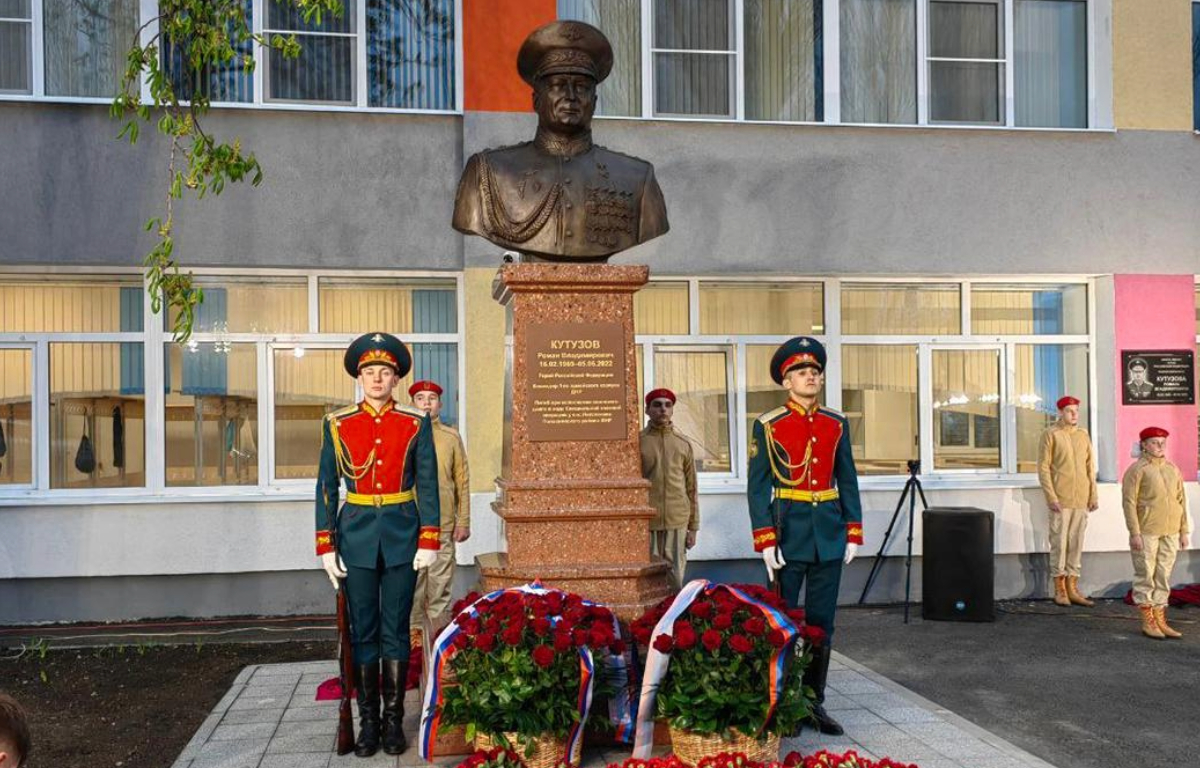
Three individual monuments to fallen members of the Armed Forces who took part in the liberation of Mariupol were also erected in the city (Lieutenant General Roman Kutuzov, 15 April 2023; Private Eduard Dyakonov, 31 July 2024; Major General Volodymyr Frolov, 14 September 2024), and one individual monument to a veteran of the Great Patriotic War (Dmytro Leliushenko, 29 April 2024).18
The four individual monuments consist of a pedestal, a bust, and an information plaque about the person depicted. They are all similar in size, colour, and style, as if they form a single composition, even though they are located in different parts of the city and refer to two different armed conflicts, more than 70 years apart. In this way, the idea that the Special Military Operation is a repetition of the Great Patriotic War is reinforced, and fallen servicemen of both conflicts are united in the common cause of fighting Nazism.
An even more expressive manifestation of this idea in the public space of the city is a mural of two Mariupol teenagers who, despite the time lapse of 70 years, are united in the common cause of defending their homeland. One of them, 14-year-old Soviet pioneer Anatolii Balabukha from Mariupol, according to local legend, put up armed resistance to the Nazi military in 1943 but was consequently shot dead. The other teenager’s name is Arsen Popov, who, according to reports in the Russian media, during the battle for the city in 2022, saved the wounded under heavy fire together with medics.19 The mural is located at school No. 60, where, in May 2022, the first Yunarmiya or “Young Army” (“Юнармия”) unit in liberated Mariupol appeared. The mural depicts two boys: on the left is a black-and-white portrait of Anatoliy Balabukha, and on the right is a portrait of saluting Arsen Popov in a red T-shirt and beret. The portraits are decorated with a St. George’s ribbon, another popular symbol of the Great Patriotic War in the Russian Federation.
This mural draws a parallel not only between the exploits of the two teenagers, but also conflates two youth organisations: the Soviet Pioneer Movement and the Russian Young Army. Both organisations were created by the state for the patriotic education of youth; in fact, the values, policies, methods of operation, and symbols of the Yunarmiya clearly resemble those of the Soviet Pioneer Movement.20 In June 2024, a number of Ukrainian media outlets even reported that Russia was recruiting local children to become “pioneers” in Mariupol. Obviously, they were referring to other youth organisations that exist in the Russian Federation, since the All-Union Pioneer Organisation of the USSR ceased to exist in 1990.21
Local exhibitions
The idea of a special connection between the two wars in Mariupol is also being enrooted through exhibitions. For instance, in early December 2023, an exhibition titled “World without Nazism” (“Мир без нацизма”) was opened inside the Priazovsky University of Mariupol. The exhibition, consisting of eighteen information banners, was dedicated to the history of Nazism from its inception to the present.22 The exhibition touched not only on the period of the Great Patriotic War and the Special Military Operation, but also on a broader chronology. The authors of the exhibition trace Ukrainian nationalism back to the Brotherhood of Saints Cyril and Methodius of 1845-1847 and emphasize the role of the Nazis in the development of the Ukrainian nationalist movement. The exhibition draws parallels between the crimes committed by German soldiers in Donbas during the Nazi occupation of the region in 1941-1943, the role of Stepan Bandera in the formation of Ukrainian nationalism, and the fact that the Special Military Operation was launched to “liberate the occupied lands under the oppression of the Kyiv regime that preaches a policy of Nazism.”23
The exhibition exploits numerous sensitive images and facts, including photographs of concentration camps in the German-occupied Donbas, the corpses of Soviet prisoners of war, and mentions statistics of the deceased in various German concentration camps in Donbas. In the section on the current armed conflict with Ukraine, a separate information banner is dedicated to photographs of children who died as a result of hostilities in Donbas and of Ukrainian soldiers with weapons and Nazi symbols.
Furthermore, in January 2024, the Mariupol Museum of Local History also opened an exhibition to mark the eightieth anniversary of the breaking of the siege of Leningrad (St. Petersburg), entitled “With Nib and Bullet” (“Пером и пулей”). The siege of Leningrad by German troops lasted from 8 September 1941 to 27 January 1944 (872 days) and resulted in enormous losses in both armies and among the city’s civilian population. This siege is one of the central Soviet myths of the Great Patriotic War.
The exhibition consisted of several informational banners with photos and texts concerning “writers-frontliners and journalists who survived the siege of Leningrad.” One of the journalists attending the opening of the exhibition wrote, “Unfortunately, many Mariupol residents experienced in our time what cold, hunger, and thirst are when they were used as human shields by Ukrainian nationalists. This seaside city is well aware of the kind of difficulties and deprivations that Leningraders faced.”24
Notably, on 1 June 2022, St. Petersburg became Mariupol’s sister city, and since then, the establishment of friendly relations between the two cities and the search for common characteristics have been gaining momentum.25 Both cities are ports, but they also share the experience of a siege. The capture of Mariupol by the Red Army in 1943 occurred much faster and with fewer casualties than its occupation by the Russian military in 2022, so drawing a diachronic parallel between the liberation of the city in 1943 and 2022 is not as strong as drawing a parallel between the severe siege of Mariupol and another Russian city that experienced a similar battle. Therefore, the emergence of the exhibition “With Nib and Bullet” can be best understood in the context of historical framing.
Lastly, in September 2024, a travelling exhibition “War by Others’ Hands” about the West’s fuelling of the war in Ukraine was opened in Mariupol for a week. The exhibition consisted of informational banners and a series of exhibits, such as fragments of Western-made munitions.26 It was created by the political movement “Donetsk Republic” with funding from the state entity “Russian Foundation for Culture.” “War by Others’ Hands” exploited the technique of historical framing to show that armed conflict in Ukraine is not the first occasion when the West has fuelled wars between other states. The exhibition aimed to show that the Western powers maintained warm relations with the Third Reich right on the eve of the war and made efforts to put Hitler and Stalin at odds.
The exhibition contains several telling compositional elements, such as the side-by-side portraits of Zelenskyi and Hitler, both standing with their heads bent over a table, as well as photos of a torchlight procession in the Third Reich in 1936 and a torchlight procession on Stepan Bandera’s birthday in Ukraine in 2017. The exhibition, much like “World without Nazism,” also uses surprisingly sensitive materials. For example, one of the information banners features two photographs depicting buildings engulfed in flames side by side: one from the village of Khatyn in Belarus and the other from the city of Odesa in Ukraine. The first photo is captioned “German Nazis and Ukrainian nationalists burning people in the Belarusian village of Khatyn, 1943,” and the second photo is captioned “Ukrainian neo-Nazis burning people in the Odesa Trade Union Building, 2014.”27 The idea of historical framing is manifested not only at the level of physical sites of remembrance, but also in the introduction of new holidays and traditions.
Official celebration ceremonies
In 2023, for the first time, Mariupol celebrated two days of liberation from the Nazi invaders: one on 10 September, as on this day in 1943 the city was liberated from German troops, and the other on 20 May, to mark the final suppression of Ukrainian resistance in the city in 2022. One holiday was named the Day of Liberation from Nazi Invaders, and the other—the Day of Liberation from Ukrainian Nazis.28
On 20 May 2023, to mark the first anniversary of the liberation from the so-called Ukrainian Nazis, local officials laid flowers at the monument to Azovstal employees who died during the Great Patriotic War. The monument is located right next to the Azovstal plant, where the last Ukrainian defenders of Mariupol took cover in May 2022.29 Once again, we see the conflation of the two wars: to commemorate the events of the Special Military Operation, officials lay flowers at the memorial relating to the Great Patriotic War, but the place itself is important in the context of the events of the Special Military Operation.
On 10 September 2022 and 2023, Mariupol organised a solemn concert programme to mark the Day of Liberation from German troops. In 2022, it took place on the square in front of the drama theatre destroyed by the Russian air force, and in 2023, within the walls of Mariupol State University. The commemoration of this day draws parallels between the dramatic events of the past and the tumultuous war that is taking place today. “For Mariupol, the events that took place on 24 February are similar [to the events of the Great Patriotic War], but in a different historical format,” said Larysa Syvolap, acting rector of the university, in a commentary to the local media.30
The new public memorials, commemorative exhibitions, and official ceremonies in the cityscape of occupied Mariupol exemplify how the Russian Federation uses the technique of historical framing to perpetuate the idea of the teleological nature of history. The conflation of histories, in this case the history of the Great Patriotic War and the more recent history of the Special Military Operation, occurs through the establishment of lieux de mémoires, as defined by Pierre Nora, such as monuments or murals, the organisation of exhibitions and concerts, the celebration of new holidays, and the declamation of speeches.31
The idea is often conveyed through the use of sensitive materials, antagonising and emotionalizing the topic of war. Suggested logic can also explain the selection of topics for parallelism: fallen war heroes, the devastating siege of the city, or the bloody crimes of the Nazis. Although this article examines the historical framing utilized by the Russian propaganda through the example of Mariupol, the feasibility of extrapolating the proposed patterns to the wider territory of both the Russian Federation and other Russian-occupied areas of Ukraine can be further discussed.
The text was developed during the “Rethinking ‘Soviet’: Modern Ukrainian Identity and the Legacy of Communism” course at the Invisible University for Ukraine and prepared for publication in collaboration with Nadiia Chervinska and Mark Baker. The research was supported by the Open Society University Network (OSUN).
- “Beneath the Rubble Documenting Devastation and Loss in Mariupol,” Human Rights Watch, February 8, 2024. [↩]
- Inside Mariupol: Russia’s new Potemkin village,” Financial Times, February 6, 2024. [↩]
- «Марат Хуснуллин проинспектировал ход восстановления Мариуполя», MK.RU, 11 декабря 2023. [↩]
- «Рабочая поездка в Мариуполь». Президент России, 19 марта 2023. [↩]
- “Inside Mariupol: Russia’s new Potemkin village.” [↩]
- Homanyuk, Mykola, and Mischa Gabowitsch. Monuments and Territory. War Memorials in Russian-Occupied Ukraine (Budapest—Vienna—New York: CEU Press, 2025), P. 1-13. [↩]
- “In occupied Mariupol, Russia’s rebuild is erasing Ukrainian identity and any evidence of war crimes,” Euronews, 22 December 2022. [↩]
- Jade McGlynn, Memory Makers: The Politics of The Past in Putin’s Russia (London: Bloomsbury, 2023), pp. 4-6. [↩]
- «Денис Пушилин и делегация из России приняли участие в открытии памятника бабушке со Знаменем Победы в Мариуполе», Глава Донецкой Народной Республики, 4 мая 2022. [↩]
- «Що відомо про українську бабусю з червоним прапором, яку Росія зробила своїм символом», BBC News Україна, 5 травня 2022. [↩]
- Ольга Демідко, «Пам’ятники Воїнам-визволителям Маріуполя», MRPL City, 9 травня 2018. [↩]
- https://t.me/Pravdivaya_pravda/1204, April 8, 2022; https://t.me/L0HMATIY/3416, April 10, 2022; https://t.me/kremlebot_24_02_2022/998, April 28, 2022. [↩]
- «Денис Пушилин и делегация из России приняли участие в открытии памятника бабушке со Знаменем Победы в Мариуполе». [↩]
- Святослав Хоменко, Єлизавета Фохт та Анастасія Платонова, «“Бабця для всієї Росії”. Як українка з прапором СРСР стала символом і що сама про це думає», BBC News Україна, 16 травня 2022. [↩]
- Роман Закурдаев та Максим Крюков, «В порту Мариуполя открыли мемориал в честь погибших при освобождении города моряков», Медиагруппа «Звезда», 31 июля 2022. [↩]
- https://2gis.ru/moscow/gallery/geo/70030076218081193, August 11, 2020; https://nathalie-zh.livejournal.com/205283.html, June 18, 2021; https://shorturl.at/hpXaG, October 2016; https://shorturl.at/zbmYy, September, 2021. [↩]
- «В Москве помянули русских воинов и болгар, отдавших свои жизни за освобождение Болгарии от турецкого ига», Вера и время, 4 марта 2010. URL; Денис Мирошниченко, «Поздравление председателя Народного Совета ЛНР с Днем освобождения Луганска от фашистов,” Луганский информационный центр, 14 февраля 2021. URL; «В Белоруссии назвали недопустимым снос памятников павшим за освобождение от фашизма», ТАСС, 5 травня 2023. [↩]
- «Андрей Турчак вместе с Денисом Пушилиным открыл памятник генерал-лейтенанту Роману Кутузову в Мариуполе», Единая Россия, 15 апреля 2023; «Денис Пушилин и Игорь Кобзев открыли в Мариуполе бюст Героя России иркутянина Эдуарда Дьяконова», Глава Донецкой Народной Республики, 31 июля 2024; Александр Сукманов, «Памятник выпускнику екатеринбургского военного училища открыли в Мариуполе», Европейско-Азиатские Новости, 28 сентября 2024. [↩]
- «В Мариуполе увековечили подвиг юного Арсена Попова», Единая Россия, 16 вересня 2022. [↩]
- Павел Кривошеев, «“Мы въезжаем в совок” — крымчане о возрождении пионерии в России и Крыму», Крым.Реалии, 19 мая 2022. [↩]
- «У Маріуполі загарбники вирішили “прийняти у піонери” українських дітей», Укрінформ, 15 червня 2024; «У Маріуполі дітей змушують ставати піонерами», АрміяInform, 15 червня 2024; «В окупованому Маріуполі росіяни вирішили “прийняти у піонери” українських дітей», Рубрика, 16 червня 2024. [↩]
- «Состоялось открытие планшетной выставки “За мир без нацизма”», ZOV Мариуполь, 5 грудня 2023. [↩]
- «Состоялось открытие планшетной выставки “За мир без нацизма”». [↩]
- Богдан Борман, «Выставка о блокаде Ленинграда открылась в Мариуполе», Военные страницы, 26 січня 2024. [↩]
- «Петербург и Мариуполь официально стали побратимами. А кто разорвал связи с Петербургом во время войны?», Бумага, 1 червня 2022. [↩]
- https://t.me/mariupol24tv/72166, September 12, 2024. [↩]
- «В Мариуполе завершилась выставка “Война чужими руками”», ZOV Мариуполь, 13 сентября 2024. [↩]
- В Мариуполе почтили память солдат, освобождавших город», Rutube, 10 сентября 2023; «Жители Мариуполя в годовщину освобождения города почтили память погибших», РИА Новости, 20 травня 2023. [↩]
- https://t.me/morgun_ov/1432, May 20, 2023. [↩]
- t.me/mariupol24tv/38272, September 10, 2023. [↩]
- Pierre Nora, “Between Memory and History: Les Lieux de Mémoire,” Representations, 26 (1989): 7–24. [↩]